

Featured Summary:
- Germany signed a €500,000 WTO funding agreement on November 9 to support trade training in developing and least-developed economies
- The Global Trust Fund finances approximately 280 activities annually, covering agriculture, digital trade, import licensing and product standards
- Germany’s cumulative contributions exceed CHF 28 million, while the WTO warns that other donors are reducing technical assistance support
- The latest contribution has no publicly identified country allocations or export targets, leaving its eventual beneficiaries to be determined through WTO programmes
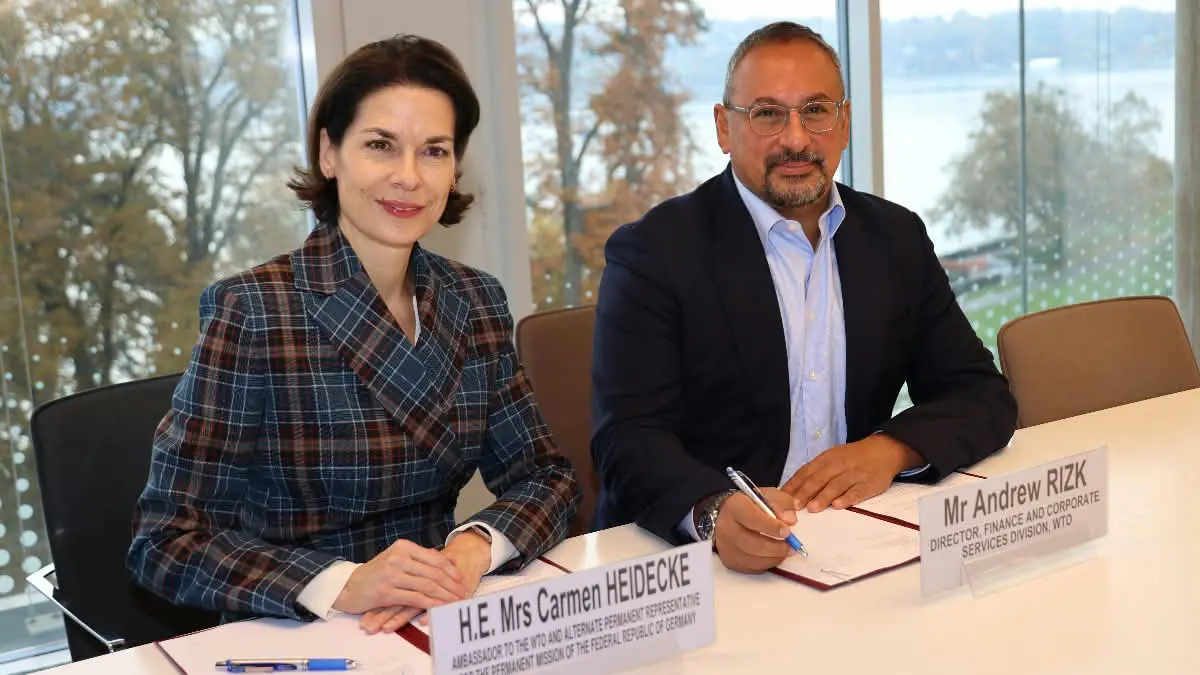
Germany committed €500,000 to the World Trade Organization’s (WTO) Global Trust Fund on November 9, 2026, to support trade-related training for developing and least-developed countries. German Ambassador Carmen Heidecke signed the agreement in Geneva.
WTO Director-General Ngozi Okonjo-Iweala said the contribution comes as other donors reduce their support for technical assistance. The fund finances programmes covering agricultural trade, digital commerce, import licensing and product standards, including training for officials responsible for implementing international trade agreements.
The WTO has not disclosed country-specific allocations for Germany’s latest contribution. The funding will support government institutions rather than provide credit directly to exporters, with participating countries and individual activities to be identified through the organisation’s technical assistance programmes.
WTO Trade Training Reaches Comoros and Timor-Leste
Comoros received WTO technical assistance in October 2025 on implementing international intellectual property rules. More than 30 participants attended a workshop in Moroni covering copyright, geographical indications and technology transfer. The programme was organised with the World Intellectual Property Organization and the Enhanced Integrated Framework.
The government subsequently requested training on intellectual property notifications and electronic submissions to the WTO in December 2025. Another request in early 2026 concerned copyright obligations. Comoros joined the WTO in 2024 and is still implementing commitments made during accession.
Timor-Leste began negotiations to join the WTO’s Government Procurement Agreement on October 14, 2026, after submitting an initial market-access offer and information on its procurement system.
The agreement governs access to public procurement markets covered by participating members’ commitments. Negotiations remain ongoing, and the WTO has not attributed the country’s accession progress to Germany’s latest contribution.
The WTO conducted more than 300 technical assistance activities in 2024, training over 19,000 officials, including more than 5,000 from least-developed countries.
Its Global Trust Fund has supported more than 2,800 workshops since 2000. The figures establish the scale of WTO training, but do not identify the countries or programmes that will receive financing from Germany’s November 2026 contribution.
Customs Reforms and Product Standards Affect Developing-Country Exporters
The World Trade Organization (WTO) identified 196 trade facilitation measures scheduled for implementation in 2025 that required technical assistance. The measures covered electronic submission of trade documents, cooperation between border agencies, customs risk management and procedures for testing imported goods.
By June 2026, 23 WTO members had implemented approximately 160 trade facilitation measures ahead of schedule. Around one-third of commitments requiring technical assistance were due between 2026 and 2030. Some governments continued requesting additional time to complete their obligations.
Food safety and agricultural product requirements are also covered by WTO assistance programmes. In June 2026, the organisation held a workshop for national authorities responsible for reporting sanitary and phytosanitary measures.
An October–November course addressed participation in the WTO committee overseeing those requirements, including how governments handle international notifications and trade concerns.
Niger presented its customs risk-management procedures at the WTO Trade Facilitation Committee’s October meeting, while Myanmar reported on transit arrangements.
Members also discussed outstanding assistance requirements and concerns about future programme funding. The WTO did not report whether these activities had reduced customs clearance times or exporters’ compliance costs.
WTO Training Declines as Donor Funding Remains Under Pressure
Donor contributions accounted for 85% of the World Trade Organization’s (WTO) technical assistance resources in 2025, with its regular budget covering the remaining 15%.
Unrestricted contributions to the Global Trust Fund remained below CHF 3 million for a second consecutive year, representing just 13% of the funding received during the 2006–2009 peak.
Five new donors contributed during the year, but three existing donors did not renew their payments and another reduced its contribution by 90%. The WTO relied on declining cash reserves and spending reductions to maintain its assistance programmes. Germany’s cumulative contributions have exceeded CHF 28 million since 2000.
More than 13,000 government officials received WTO training in 2025, down 31% from the previous year. Programmes remained available to 140 members and observers, with least-developed countries accounting for 29% of participants. The organisation reported that 80% of its performance targets were fully or partially achieved.
The WTO delivered 65% of its activities outside e-learning through a combination of in-person, virtual and self-paced instruction, while another 16% were conducted entirely online.
The figures reflect the organisation’s training arrangements in 2025, although its published results do not establish how much of the decline in participation resulted directly from reduced donor contributions.
WTO’s 2026–2027 Programme Sets Next Trade Assistance Priorities
The World Trade Organization’s (WTO) 2026–2027 technical assistance programme covers trade negotiations, customs procedures, agricultural trade, product standards and government procurement.
National and regional training activities will also address fisheries subsidies and intellectual property obligations, including assistance for countries negotiating WTO membership.
Kenya is scheduled to host a regional agricultural trade workshop from November 11–13, 2026. Tunisia will receive public procurement training from November 30 to December 3, followed by agricultural notification training in Colombia from December 1–3.
Bangladesh has a December 7–10 programme covering intellectual property obligations, public health and the implications of graduating from least-developed country status.
The WTO’s 2025 technical assistance report recorded progress in helping governments address outstanding trade notification requirements through specialised training and follow-up activities.
Its Trade in Services for Development initiative also developed and tested diagnostic tools for assessing national services policies. The report did not establish how much additional trade resulted from these programmes.
The WTO’s Technical Assistance Management System records programme activities, participating countries and evaluation results. The scheduled training will provide further evidence of the assistance delivered, while national implementation records will determine whether governments have completed the reforms covered by the programmes. Germany’s latest funding commitment does not yet have publicly identified country allocations or measurable export outcomes.


Recent Comments