

Last updated: December 12, 2025
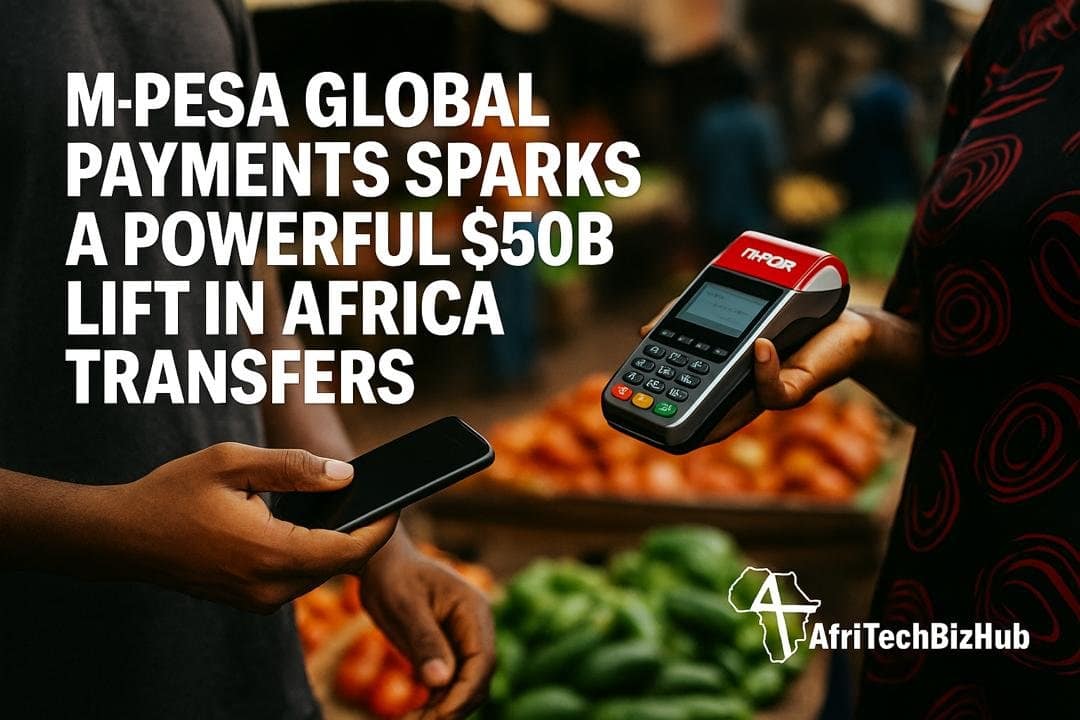
M-Pesa Global Payments Drives a Powerful Boost in Africa’s $50B Cross-Border Economy
Featured Summary:
- M-Pesa Global Payments brings instant, low-fee cross-border transfers to Africa, extending powerful corridors through Visa, Alipay, MTN Uganda, and Thunes.
- Africa’s remittance and digital-commerce economy gains a major lift, reducing FX opacity, settlement delays, and costly bank rails.
- Individuals, SMEs, freelancers, and online businesses unlock faster payouts and clearer FX, strengthening participation in regional and global trade.
- The launch deepens Africa’s payment integration, complementing PAPSS and reinforcing the continent’s shift toward unified digital payments and AfCFTA-aligned commerce.
The M-Pesa Global Payment launch signals a major upgrade in Africa’s cross-border payment landscape, enabling instant, low-fee transfers across key Sub-Saharan corridors. As Asia and Latin America accelerated through interoperable digital rails, Africa is now entering its own transformation phase, where mobile money dominance, PAPSS-aligned systems, and fast-growing ecommerce flows reshape how consumers, SMEs, and freelancers move value across borders.

Why M-Pesa Global Payment Matters for Africa’s Cross-Border Payments
Vodacom Tanzania’s launch of M-Pesa Global Payment marks a structural upgrade in Africa’s payment landscape. By enabling instant cross-border transfers through Visa, Thunes, Alipay, and MTN Uganda, M-Pesa moves from being a domestic wallet to a regional money rail, giving individuals and businesses faster, cheaper, and more transparent access to global financial flows, a shift that aligns with the continent’s broader fintech acceleration and deepening digital rails.
Mobile Money Becomes a True Cross-Border Rail
This launch turns M-Pesa into a functional cross-border infrastructure layer, enabling:
• Instant wallet-to-wallet transfers across countries
• Seamless ecommerce and digital-service payments
• Freelancer and SME payouts without banks
• Near-real-time settlement using partner networks
It breaks long-standing fragmentation, allowing mobile money to operate like a regional payment network rather than isolated national systems.
A Direct Challenge to Africa’s High Remittance Costs
M-Pesa Global Payment directly attacks the continent’s 7–9% average remittance costs by offering:
• Lower fees than banks and MTOs
• Transparent FX rates
• Fewer intermediaries
• Faster settlement
This mirrors the transformation seen in Asia and Latin America, where digital wallets radically undercut traditional remittance channels.
Why Tanzania Is the Strategic Launchpad
Tanzania offers the ideal environment for cross-border expansion:
• High M-Pesa penetration
• Deep mobile-money usage across SMEs and consumers
• Strong digital-payment regulation
• Growing freelancer and digital-commerce activity
It positions Tanzania as a natural gateway for broader East African and pan-African corridors.
Strengthening Africa’s Path Toward Payment Integration
This launch complements Africa’s broader shift toward payment integration. By improving liquidity and inter-wallet connectivity, M-Pesa builds practical, on-the-ground rails that support:
• AfCFTA cross-border trade
• PAPSS settlement frameworks
• Mobile-money and fintech interoperability
• Lower-cost Africa-to-Africa transactions
It accelerates the continent’s move toward a unified settlement ecosystem, one where regional commerce no longer depends on expensive international rails.

How M-Pesa Global Payment Repositions Africa’s Fintech Landscape in 2025
M-Pesa Global Payment arrives at a decisive moment in Africa’s digital economy shift. The continent is moving from isolated national payment systems to interoperable regional rails powering trade, remittances, ecommerce, and digital services. This expansion boosts Africa’s capacity to move money seamlessly across borders with greater speed, transparency, and lower FX friction, reinforcing the continent’s transition toward smarter, multi-rail digital payment infrastructure.
East Africa: The Region Driving Africa’s Cross-Border Wallet Innovation
East Africa remains the strongest foundation for cross-border digital payments because of:
• Industry-leading mobile-money penetration in Kenya, Tanzania, Uganda, Rwanda
• Mature telecom–bank integration
• Active SME, freelancer, and regional remittance corridors
• Strong regulatory support for wallet interoperability
M-Pesa Global Payment scales this maturity outward, extending East Africa’s leadership into wider global corridors.
Nigeria, Ghana & Egypt: High-Volume Corridors for the Next Wave of Expansion
M-Pesa’s cross-border strategy naturally aligns with Africa’s biggest inbound–outbound payment markets:
• Nigeria — Africa’s largest diaspora remittance economy and strong fintech density
• Ghana — interoperable mobile-money systems with rising SME digital adoption
• Egypt — a major remittance hub with accelerating ecommerce growth
These markets provide large transaction volumes, active digital workers, and strong demand for real FX transparency.
Global Partners Deepen M-Pesa’s Connectivity Across Africa
Partnerships with Visa, Thunes, Alipay, and MTN Uganda give M-Pesa immediate access to:
• Global merchant networks
• Multi-currency settlement channels
• Faster diaspora remittance pathways
• Better infrastructure for SME and freelancer payouts
This positions M-Pesa as a competitive alternative to banks and traditional remittance operators.
Strengthening Continental Rails: PAPSS, Mobile Money & AfCFTA Trade Flows
M-Pesa Global Payment complements and enhances Africa’s continental payment architecture by improving retail and SME-level liquidity across:
• PAPSS — Africa’s local-currency settlement rail
• Mobile-money interoperability across regional blocs
• AfCFTA-aligned digital trade systems
• Fintech APIs powering cross-border payouts
Together, these rails create a more integrated Africa-to-Africa payment environment, critical for remittances, trade, and digital commerce.

What Opportunities M-Pesa Global Payment Unlocks for Africans in 2025
M-Pesa Global Payment creates real economic value by enabling low-cost, instant, multi-currency transfers across African markets. It reduces the continent’s high remittance fees, strengthens SME cash flow, improves digital-worker payouts, and deepens the infrastructure layer powering Africa’s fintech rise, making it easier for more Africans to participate in emerging AfCFTA-driven opportunities.
Opportunities for Individuals: Lower Fees & Instant Cross-Border Transfers
Individuals gain:
• Cheaper remittances compared to banks and cash agents
• Instant USD/GBP/EUR withdrawals for families and freelancers
• Transparent FX rates with no hidden charges
• Global access via Visa, Thunes, Alipay, MTN
This directly reduces Africa’s 7–9% average remittance cost, one of the highest globally.
Opportunities for SMEs & Businesses: Faster Regional Trade Payments
SMEs now benefit from:
• Real-time supplier and partner payments across African markets
• Simplified B2B multi-currency settlements
• Faster cross-border payroll processing
• Lower dependence on slow, costly bank rails
This is especially important for AfCFTA-aligned SMEs that struggle with delays and liquidity gaps in regional trade.
Opportunities for Freelancers & Digital Workers: Reliable Global Payouts
M-Pesa improves income flow for Africa’s digital workforce:
• Instant payouts from global platforms
• Lower payout fees vs PayPal/Payoneer/banks
• Better access to global marketplaces
• Predictable settlement, improving income stability
This strengthens Africa’s participation in the global remote-work economy.
Opportunities for Investors: Infrastructure Growth & Corridor Expansion
Investors see upside in:
• Increasing cross-border payment volumes
• Disruption of traditional money-transfer operators
• Rising demand for multi-currency infrastructure
• Telco–fintech–global network partnerships
This expansion fits into Africa’s wider payment-modernization push, reinforced by the continent’s rising digital-economy and fintech-infrastructure trends.

Data, Trends & Predictions: What Signals Reveal About M-Pesa Global Payment (2025–2030)
M-Pesa Global Payment launches at a moment when Africa’s cross-border payment demand is surging, remittance fees remain the highest worldwide, and digital wallets are replacing cash for regional commerce. Verified data from global institutions shows a structural shift in how Africans move money, and M-Pesa’s new global rails fit directly into that transition.
Africa’s $54B Remittance Market Is Pushing Toward Cheaper Digital Transfers
- Africa received $54 billion in remittances in 2023, per the World Bank’s Migration & Development Brief.
- Remittance fees to Sub-Saharan Africa averaged 7.9% — the highest in the world.
- Mobile-money adoption continues to accelerate across Africa, with transaction volumes rising over 15% in 2024 and Sub-Saharan Africa accounting for 74% of the world’s 108.4 billion mobile-money transactions (GSMA, State of the Industry Report on Mobile Money 2025).
Insight: M-Pesa Global Payment directly targets the continent’s largest and most expensive pain point — sending money.
Tanzania’s Mobile-Money Ecosystem Creates a High-Velocity Launch Market
- Tanzania maintains 70%+ mobile-money penetration, among the highest globally (GSMA State of Mobile Money Report).
- Vodacom M-Pesa already processes billions in annual P2P and merchant transactions.
- Digital payments in Tanzania have grown ~25–30% yearly since 2020.
Insight: A market already operating at massive mobile-money scale gives M-Pesa Global Payment immediate liquidity and rapid adoption potential.
Global Payment Partnerships Are Expanding Africa’s Cross-Border Corridors
- Visa, Thunes, Alipay, and MTN Uganda power real-time corridors across 80+ global markets.
- Thunes connects to ~4 billion bank accounts and mobile wallets worldwide.
- East Africa’s high-volume Tanzania–Kenya–Uganda corridors are projected to grow 20–25% annually (GSMA & Thunes Insights).
Insight: M-Pesa Global Payment gives Africans direct access to global liquidity, without banks acting as intermediaries.
Predictions (2025–2030): The Next Stage of M-Pesa’s Pan-African Expansion
- Africa’s Largest Remittance Corridors Will Accelerate
Likely expansion markets based on demand + regulation:
• Kenya
• Uganda
• Ghana
• South Africa
• Nigeria (potential, pending regulatory alignment)
- Remittance Costs Could Drop From 7.9% to 3–5%
Competition among digital rails — M-Pesa, PAPSS, fintech APIs — is expected to drive down transfer costs by 2027.
- The Freelancer & SME Economy Will Benefit the Most
Cross-border payouts for remote workers and merchants may grow 15–20% annually.
- Telco-Fintech Interoperability Becomes a Continental Priority
Expect stronger wallet-to-wallet links between:
• M-Pesa
• MTN MoMo
• Airtel Money
• PAPSS-connected banks
- PAPSS Integration Will Become Strategically Unavoidable
As AfCFTA trade intensifies, M-Pesa’s global corridors will increasingly complement PAPSS per-second settlement for intra-Africa trade.
Insight: The years 2025–2030 will determine whether Africa achieves a unified, low-cost, continent-wide digital payment network, and M-Pesa Global Payment is now part of that evolution.

Connecting the Dots: Africa’s Cross-Border System Is Converging
Africa is now entering a decisive phase where fintech rails, mobile money, and continental payment systems are converging for the first time. M-Pesa Global Payment joins a fast-expanding network that includes PAPSS, COMESA Digital Payment Platform, and even the recent PAPSS × Cowry partnership, reducing the cost and friction of sending money across borders. These interoperable layers mirror the digital-economy momentum already transforming Africa’s markets, where mobile money dominates daily transactions and fintech platforms anchor trade, remittances, and freelancer payouts. The result is a more liquid, more connected financial system that supports Africa’s next stage of growth.
This integration aligns perfectly with AfCFTA’s business opportunity wave, opening smoother payment corridors for SMEs, exporters, freelancers, and digital businesses. As borders become easier to navigate and cross-border settlement becomes faster and more transparent, Africa’s digital economy gains the infrastructure it has long needed to scale. For individuals, it means cheaper global access; for SMEs, it means faster cash cycles; for investors, it signals a continent where payments, trade, and digital value creation are finally aligning. M-Pesa’s expansion is not a standalone update, it is part of a continental shift toward a future where Africa trades, pays, and grows on its own rails.
Opportunities Ahead for Africa’s Digital Payment Future
Africa is entering a new financial era, one where systems like M-Pesa Global Payment, PAPSS, COMESA digital rails and AfCFTA trade frameworks finally begin working in the same direction. This convergence unlocks a future defined by lower barriers, faster settlement, borderless participation, and continent-wide economic mobility. As cross-border payments become cheaper and instant, Africa’s entrepreneurs, freelancers, SMEs, and consumers gain the tools to trade confidently, expand income opportunities, and plug directly into the global digital economy. The momentum now building across the continent signals not just progress, but the start of a long-term cycle of modernization that will keep accelerating Africa’s growth.


Recent Comments