


Last updated: July 31, 2026
Featured Summary:
- Digital currency investments in Kenya are moving under a licensing system that will regulate exchanges, custodians, brokers, token issuers and payment-related providers.
- Cryptocurrency investment firms serving Kenyan customers may require authorisation even when they have no physical office in the country.
- The reported $19 billion represents estimated on-chain cryptocurrency value received by Kenya, not foreign investment permanently entering the economy.
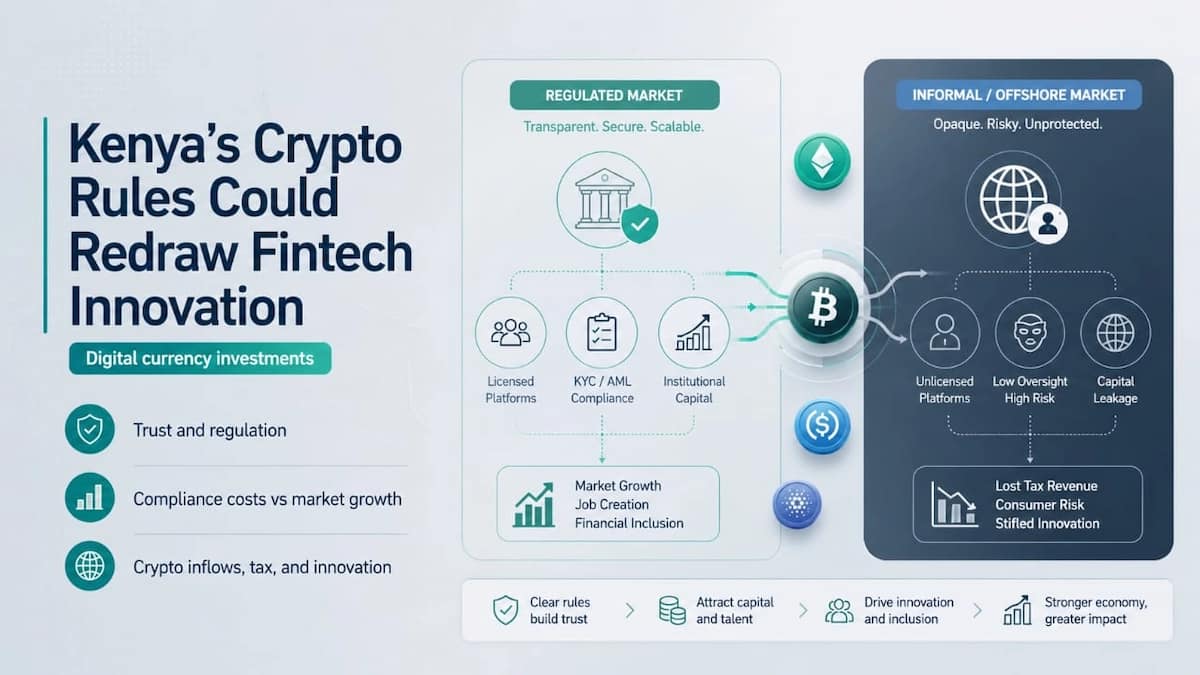
- Kenya’s regulation could protect crypto inflows by improving trust, but high compliance costs could redirect activity to offshore or informal platforms.
Kenya has moved beyond debating whether cryptocurrency should exist outside its financial system.
The Virtual Asset Service Providers Act, which took effect in November 2025, created a legal framework for licensing businesses that offer digital asset services in or from the country.
Draft regulations published by the National Treasury in 2026 now set out how those licences, governance standards, consumer safeguards and supervisory responsibilities could operate.
The framework does not prohibit individuals from holding or trading cryptocurrencies, but it changes the conditions under which companies may provide the exchanges, wallets, custody and investment services that make those transactions possible.
The policy shift follows rapid market growth.
Chainalysis estimated that Sub-Saharan Africa received more than $205 billion in on-chain cryptocurrency value between July 2024 and June 2025, while market estimates place Kenya’s share at about $19 billion.
That figure does not represent $19 billion of foreign capital invested in Kenyan companies or held permanently inside the economy.
It measures the estimated value of crypto received through blockchain transactions attributed to Kenyan users and services, including trading, transfers, remittances and funds that may later leave the country.
Kenya’s crackdown threatens part of that activity only if the cost of entering the regulated market becomes greater than the trust and institutional participation the rules are intended to create.

How Will Kenya’s New Digital Asset Rules Reshape Digital Currency Investments?
Kenya’s new rules will reshape digital currency investments by replacing regulatory ambiguity with a formal licensing perimeter.
The Act applies to companies providing virtual asset services in Kenya, while the draft regulations extend that reach to businesses that derive economic benefit or income from the country even when they have no physical presence there.
Covered activities include operating trading platforms, exchanging virtual assets for fiat currency or other assets, transferring digital assets, providing custody, arranging virtual asset offerings and supplying related investment or payment services.
Foreign platforms will therefore not be able to treat Kenyan customers as outside the reach of domestic supervision simply because their headquarters and servers are located elsewhere.
For individual investors, buying, holding or selling a digital asset does not automatically become illegal under the framework.
The practical change is that regulated services will need to be provided through authorised businesses that meet disclosure, governance and customer-protection standards.
Investors may face stricter identity checks, more detailed transaction records and a smaller selection of platforms or tokens where providers decide that certain products are too risky or expensive to support.
Existing accounts will not necessarily disappear, but firms that fail to obtain the required licence may have to stop serving Kenyan users.
The rules therefore regulate access to digital currency investments through intermediaries rather than prohibiting personal ownership of crypto assets.
How are Cryptocurrency Investment Firms Adapting to Kenya’s New Rules?
Cryptocurrency investment firms must first determine whether their business falls inside the new licensing perimeter and which authority will supervise it.
The Central Bank of Kenya and the Capital Markets Authority receive regulatory responsibilities under the Act, with the precise supervisor determined by the service offered.
A company may need to disclose its ownership, directors, financial position, operating model and sources of capital before receiving approval.
It must also demonstrate that it can manage cybersecurity threats, keep reliable records, monitor suspicious transactions, handle customer complaints and protect client assets from the company’s own financial risks.
These are confirmed obligations arising from formalisation; mergers, market exits and new partnerships are possible commercial responses rather than requirements contained in the law.
Large international exchanges may be better placed to absorb licence fees, legal expenses and compliance staffing, while smaller Kenyan firms may limit their services or seek additional capital.
The risk is that regulation concentrates the market around a few well-funded providers.
The opportunity is that firms able to prove regulatory credibility may gain stronger banking relationships, attract institutional investors and compete for customers who previously avoided cryptocurrency because custody and consumer protection were unclear.
How will New Rules Change the Role of Virtual Asset Service Providers?
The framework changes a virtual asset service provider from an unregulated technology platform into a supervised financial intermediary.
Exchanges will be responsible for identifying customers, retaining transaction records and detecting activity linked to money laundering or terrorism financing.
Custody providers will need systems that protect private keys and separate client property from operational funds.
Brokers and investment platforms will be expected to disclose fees and risks clearly, while businesses conducting virtual asset offerings may need to publish prescribed information before soliciting investor funds.
A licence will therefore carry continuing responsibilities rather than acting as a one-time approval to enter the market.
Regulation will also give authorities greater visibility over who operates in the market and where responsibility lies when customers lose access to funds, receive misleading information or encounter a platform failure.
It cannot protect investors from falling token prices, guarantee that a digital asset has economic value or eliminate fraud conducted outside licensed services.
Peer-to-peer transfers may also remain difficult to supervise when no regulated intermediary processes the transaction.
The market becomes more institutional only when licensed providers maintain reliable custody, transparent pricing and effective complaint procedures without making legal access more expensive than unregulated alternatives.
How Are Crypto Inflows Influencing Kenya’s Digital Asset Economy?
Crypto inflows are influencing policy because the market has grown large enough to intersect with payments, investment, remittances, taxation and cross-border capital movements.
The $19 billion estimate should be read as transaction activity, not as a stock of assets sitting in Kenyan accounts.
On-chain value received can include the same assets moving between wallets, purchases through exchanges, stablecoin transfers, investment trades and payments subsequently converted or sent abroad.
It therefore shows the scale of participation but cannot by itself establish how much productive capital entered Kenya, how much income investors earned or how much money remained in the country.
The volume still explains why policymakers want stronger reporting and supervision.
A market of that size can support lower-cost transfers, new investment services and digital settlement, but it can also obscure taxable gains, expose consumers to platform failures and move funds through businesses whose ownership or financial condition is unknown.
Digital asset income may arise from trading gains, business payments or other crypto-related activity, but licensing a service provider does not by itself determine every user’s tax liability.
The immediate regulatory objective is to make the intermediaries handling crypto inflows identifiable and accountable.
Clear tax guidance, secure handling of personal data and proportionate reporting rules will still be necessary to prevent legitimate users from moving outside the supervised market.
How will Digital Asset Regulation Shape Kenya’s Fintech Innovation?
Digital asset regulation can strengthen Kenya’s fintech innovation by giving banks, payment companies, investors and entrepreneurs a defined legal route into the market.
Licensed businesses could build custody services, compliant exchanges, cross-border settlement products, tokenised investments and stablecoin-based payment tools without operating under constant uncertainty over whether regulators may later reject the entire business model.
The National Treasury’s own regulatory impact assessment states that the objective is to create a safe, transparent and innovative virtual asset environment, confirming that formalisation is intended to enable regulated activity rather than eliminate it.
The threat to Kenya’s $19 billion in crypto inflows lies in regulatory design, not regulation itself.
High entry costs, unclear licence categories, slow approvals or rules designed only for global exchanges could push local firms and ordinary users towards offshore platforms and direct peer-to-peer trading, reducing the visibility regulators are trying to gain.
Proportionate standards could produce the opposite outcome by removing unreliable operators and giving institutional capital greater confidence in digital currency investments.
Kenya will protect its position as an African fintech hub only if its framework makes regulated innovation more commercially attractive than operating beyond the reach of the formal financial system.


Recent Comments