

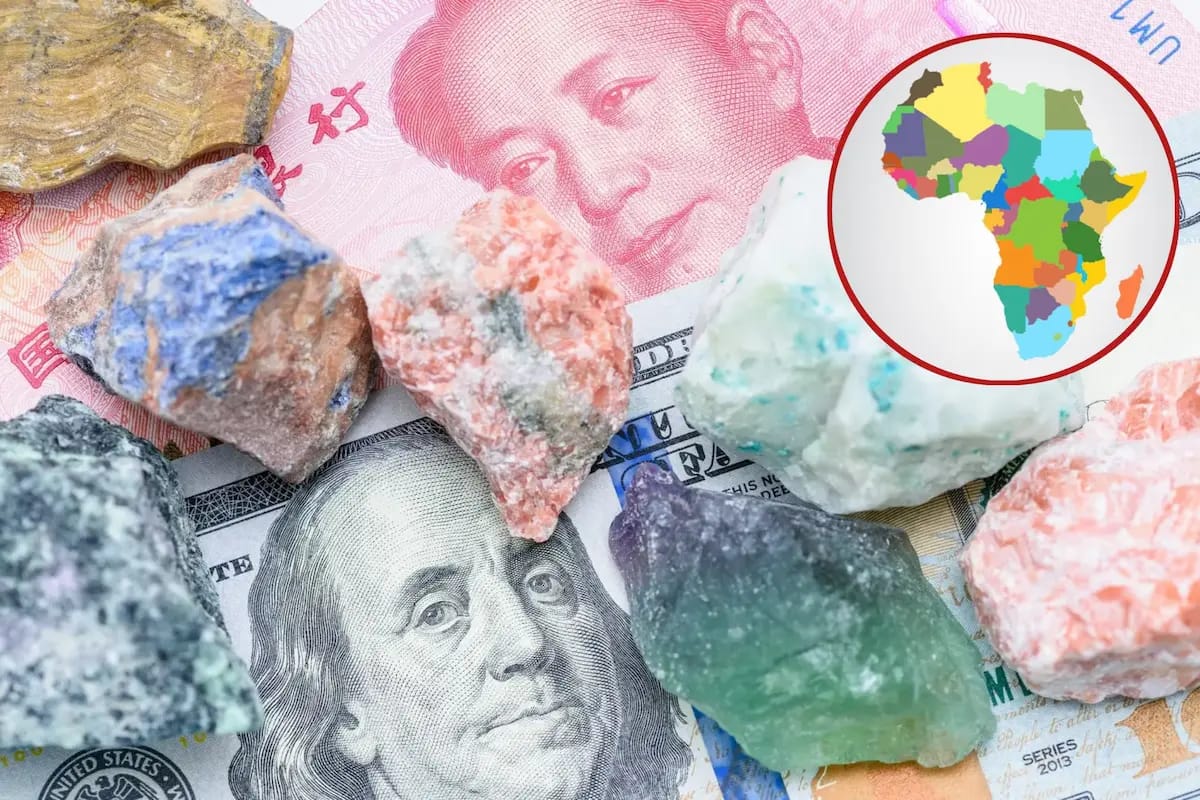
Featured Summary:
- Africa critical minerals have become essential to the global technology economy
- Africa exports more critical minerals than it processes
- Investment is securing mineral supply faster than local value creation
- The next opportunity is capturing value before minerals leave Africa
Artificial intelligence, electric vehicles, defence systems and advanced manufacturing depend on a group of minerals that Africa holds in abundance.
Governments, manufacturers and investors are competing to secure long-term supplies, while new investment continues to expand mines, transport corridors and mineral supply chains across the continent.
Most of Africa’s critical minerals leave the continent before they are refined, processed or manufactured into higher-value products.
Foreign investment continues to strengthen extraction and supply, while much of the industrial value is created elsewhere.
Africa has become indispensable to the global technology economy. Capturing more of the value created from its critical minerals has become the continent’s next economic benchmark.
Africa Critical Minerals Have Become the World’s Strategic Resource
The technologies driving the next phase of global economic growth are drawing demand toward the same group of minerals.
Artificial intelligence requires larger data centres and electricity networks. Electric vehicles, battery storage, power grids and advanced manufacturing are expanding demand for lithium, cobalt, graphite, copper, manganese and rare earth elements.
Critical minerals have moved beyond industrial commodities to become strategic economic assets because they now underpin multiple high-growth industries at the same time.
The International Energy Agency projects continued growth in demand for minerals essential to clean energy technologies, while governments in the United States, Europe and China are strengthening policies to secure long-term supply.
The competition has shifted from discovering mineral deposits to securing reliable access for industries expected to drive the next phase of global economic growth.
Global demand has transformed Africa’s minerals into strategic assets.
Extraction Is Expanding Faster Than Industrialisation
Africa critical minerals continue to enter global supply chains largely as raw or minimally processed exports.
The Democratic Republic of Congo and Zambia remain major suppliers of copper and cobalt, Guinea dominates bauxite exports, while Mozambique, Madagascar and Namibia continue expanding production of graphite and other strategic minerals.
Mining remains the dominant commercial model across much of the continent, while refining, processing and manufacturing continue to account for a smaller share of mineral activity.
Several governments have started shifting policy toward domestic processing, but those efforts remain the exception rather than the continental model.
Zimbabwe has restricted exports of unprocessed lithium to encourage local processing, Namibia is promoting mineral beneficiation, South Africa retains the continent’s strongest refining and mineral-processing base, and Morocco is expanding battery manufacturing and processing capacity.
Most African economies still export minerals before the highest-value industrial activities begin. Africa is supplying the minerals, but not capturing the industry.
Investment Is Following Minerals More Than Manufacturing
International capital is concentrating on securing reliable supplies of Africa critical minerals rather than expanding industrial production inside the continent.
Recent U.S. initiatives have prioritised mine development, transport corridors, geological mapping and supply-chain resilience, while the Lobito Corridor is being positioned to move larger volumes of copper, cobalt and other strategic minerals from Central Africa to global markets.
The investment is strengthening access to mineral supply before expanding the industries that transform those minerals into higher-value products.
The International Energy Agency reports that refining capacity for many critical minerals remains concentrated in a small number of countries despite growing global investment in new supply.
Lithium, cobalt, graphite and rare earth processing continue to take place largely outside Africa, where batteries, advanced materials and other manufactured products capture significantly more value.
Capital is securing the minerals. Industrial value is still being created elsewhere.
Africa’s Next Mineral Boom Will Be Measured by Value Capture
The next phase of Africa critical minerals will not be defined by larger discoveries or higher export volumes.
It will be defined by the share of refining, processing and manufacturing that remains on the continent before those minerals enter global supply chains.
The next commercial winners will capture more value from the resources they already produce rather than exporting larger volumes of raw materials.
The crude oil era established the cost of exporting strategic resources without building the industries around them. Critical minerals present a different commercial benchmark.
The next mineral boom will be measured by what Africa builds, not simply by what it mines.


Recent Comments