

Featured Summary:
- Ghana cocoa exports are expanding into new global markets.
- The Gulf is becoming an important hub for cocoa trade.
- Trade diversification is strengthening Ghana’s export strategy.
- Future cocoa leadership will depend on value creation as much as production.
Ghana’s cocoa trade is no longer defined only by the volume it ships abroad.
Ghana cocoa exports are reaching a wider mix of markets as buyers look beyond traditional supply channels and Ghana strengthens links with faster-growing trade corridors.
The shift is changing where cocoa moves, which commercial relationships matter and how the country positions itself within the global value chain.
For Ghana, the strategic gain lies in reducing dependence on established buyers while securing more resilient demand and greater long-term value from one of its most important exports.
Why Are Ghana’s Cocoa Exports Targeting Gulf Markets?
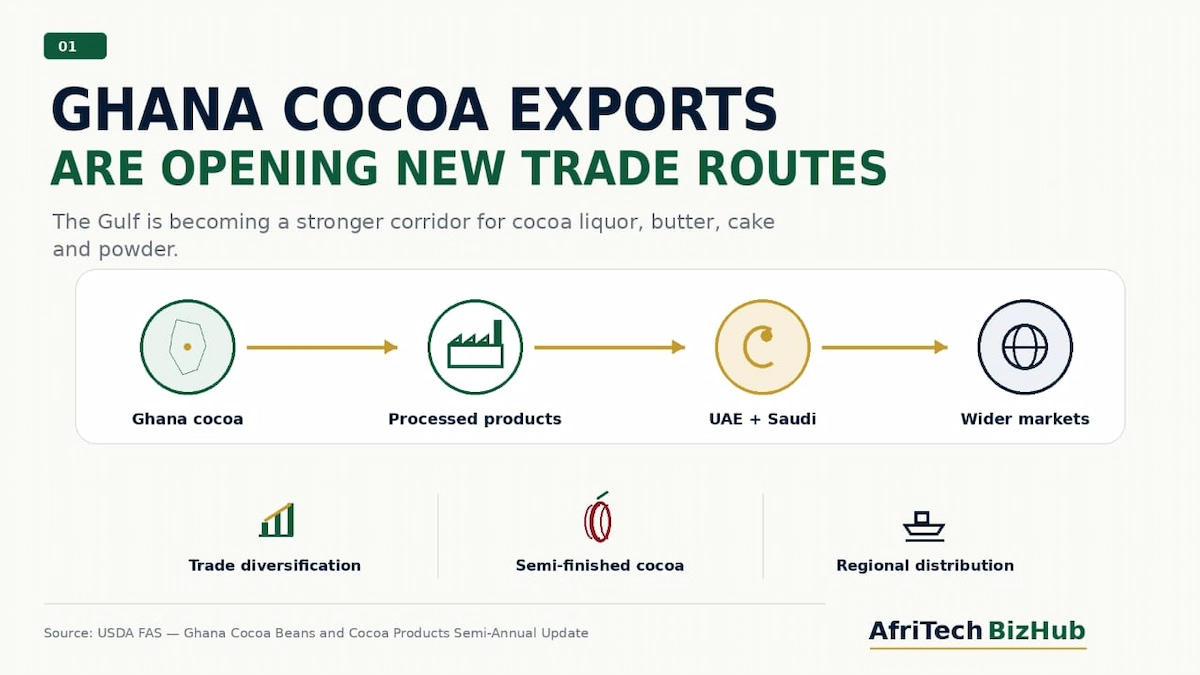
Ghana cocoa exports are targeting the Gulf to reduce dependence on a trade structure still concentrated around Europe, North America and a small group of Asian buyers.
Ghana has secured offtake commitments in the United Arab Emirates and Saudi Arabia for cocoa liquor, butter, cake and powder, extending its reach beyond raw-bean sales into higher-value semi-finished products.
The move broadens Ghana’s customer base while creating additional demand for its domestic processing industry.
The Gulf offers more than an additional export destination.
The UAE is strengthening its role in cocoa processing, storage, financing and regional distribution, while Saudi Arabia’s food industry requires cocoa ingredients for confectionery, beverages, bakery products and packaged foods.
Supplying these markets allows Ghana to connect its processing capacity to commercial networks serving the Middle East and parts of Asia, turning market expansion into stronger trade resilience and longer-term international partnerships.
How Will the Global Cocoa Market Benefit From Ghana?
Ghana cocoa exports can strengthen the global cocoa market by widening the routes through which beans and processed products reach manufacturers.
Trade has traditionally centred on established buyers and processing hubs, leaving supply chains vulnerable when production declines, shipping networks tighten or demand becomes concentrated in a limited number of markets.
Ghana’s expansion into new commercial corridors gives buyers additional sourcing relationships while connecting cocoa supply to a broader range of regional distribution networks.
A wider export base also makes cocoa trade more flexible.
Stronger links with emerging markets can distribute demand across more destinations, expand access to cocoa liquor, butter, powder and other processed products, and reduce dependence on raw-bean trade alone.
Ghana’s evolving export strategy therefore supports greater market access, more adaptable trade flows and stronger long-term commercial stability across the global cocoa industry.
Why Is Cocoa Trade Shifting Toward the UAE and Saudi Arabia?
The shift toward the UAE and Saudi Arabia is not simply about finding two new destinations for cocoa.
The Gulf is developing the infrastructure to connect producers with traders, processors, financiers and buyers across several regions.
Dubai’s DMCC Cacao Centre brings sourcing, storage, processing, trade finance and global distribution into one commercial platform, supported by an existing cluster of businesses involved in cocoa trading, chocolate manufacturing and confectionery.
This gives Ghana cocoa exports access to a market designed to move cocoa beyond domestic consumption and into wider international supply chains.
Saudi Arabia is pursuing a similar transformation through a national strategy that positions the country as an industrial and logistics hub linking Africa, Asia and Europe.
Investments in integrated transport networks, logistics zones and stronger international connectivity expand its capacity to receive commodities, support local manufacturing and distribute products across regional markets.
As these capabilities deepen, the UAE and Saudi Arabia can serve as new corridors for commodity trading, regional processing and onward distribution, giving Ghana a broader commercial route beyond its established buyer relationships.
Who Is the Largest Buyer of Cocoa From Ghana?
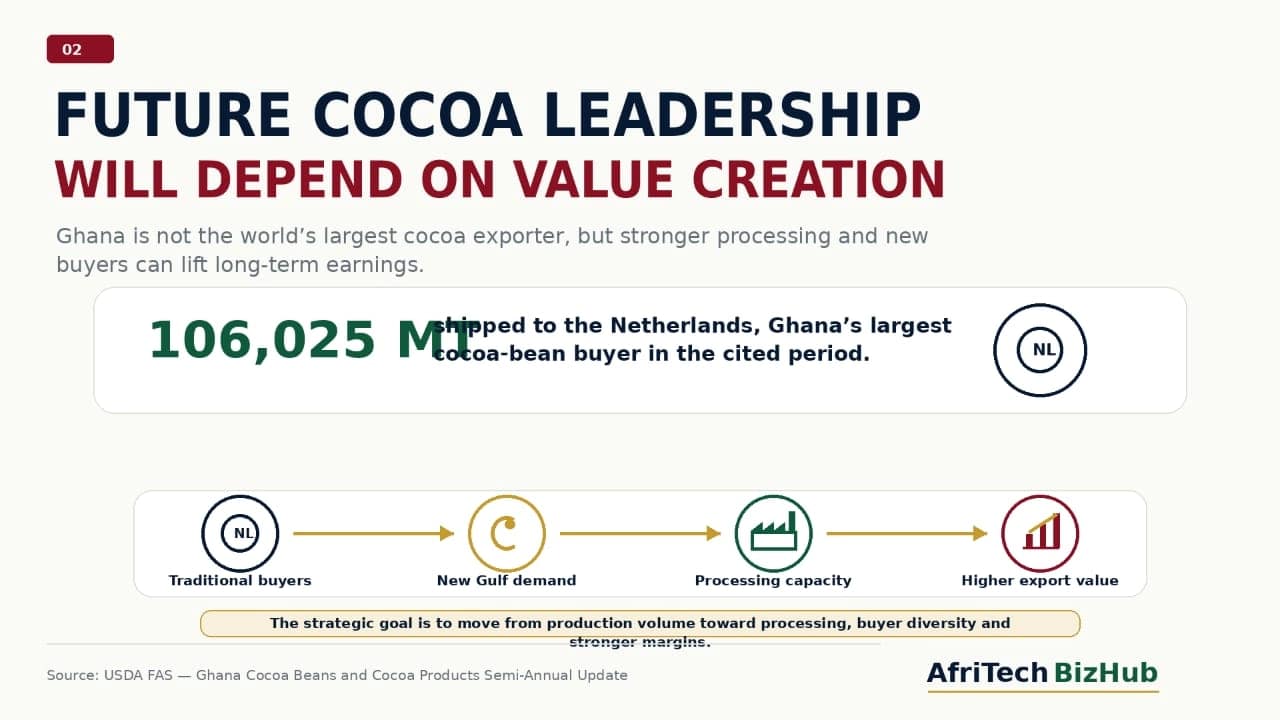
The Netherlands was the largest individual-country buyer of cocoa and cocoa preparations from Ghana in 2025.
According to the latest available World Bank WITS data, drawn from UN Comtrade, Dutch imports from Ghana were valued at about $1.22 billion.
The European Union collectively remained the largest regional market, importing approximately $2.97 billion, while the United States, Japan and Turkey followed among the leading national buyers.
Traditional European buyers therefore remain central to Ghana cocoa exports, but dependence on a small group of markets also creates concentration risk.
Expanding sales into the Gulf and other emerging destinations can distribute demand more evenly, give Ghana access to a wider pool of buyers and strengthen its position during changes in European demand or regulation.
A broader customer base supports more stable trade relationships, stronger commercial leverage and greater export resilience.
Is Ghana the Largest Cocoa Exporter in the World?
No. Côte d’Ivoire remains the world’s largest cocoa exporter, while Ghana ranks among the leading exporters alongside Ecuador and Cameroon.
In the 2024/2025 marketing year, Côte d’Ivoire exported more than 1.05 million metric tonnes of cocoa beans, compared with Ghana’s estimated 367,000 tonnes.
Côte d’Ivoire also produced about 1.75 million tonnes during the season, nearly three times Ghana’s estimated 600,000 tonnes.
Production leadership, however, does not automatically translate into the greatest economic return.
Ghana has installed cocoa-processing capacity of about 504,780 tonnes, yet processors have operated at half of that capacity or less because of inconsistent bean supply.
Expanding Ghana cocoa exports into new markets while strengthening domestic processing and manufacturing would shift competition from volume alone toward higher export earnings, industrial development and greater control over the cocoa value chain.


Recent Comments