

Last updated: June 13, 2026
Featured Summary:
- Africa natural capital is enormous, yet the continent still faces elevated borrowing costs.
- Investors lend against institutional credibility and revenue certainty, not resource potential alone.
- African resources do not automatically translate into national wealth or lower financing costs.
- Converting natural capital into investable economic value remains one of Africa’s largest financial challenges.
Africa’s natural capital story is no longer a question of abundance.
The continent possesses vast mineral reserves, agricultural resources, forests, water systems, biodiversity assets, and energy potential.
The paradox is that resource wealth has not translated into cheaper capital.
Global markets continue pricing many African economies as high-risk borrowers despite the continent’s vast stock of natural assets.
Investors do not finance potential.
They finance confidence.
That disconnect is becoming increasingly important as governments search for financing to fund infrastructure, industrialisation, climate adaptation, and long-term economic growth.
Why Does Africa Natural Capital Fail Investors?
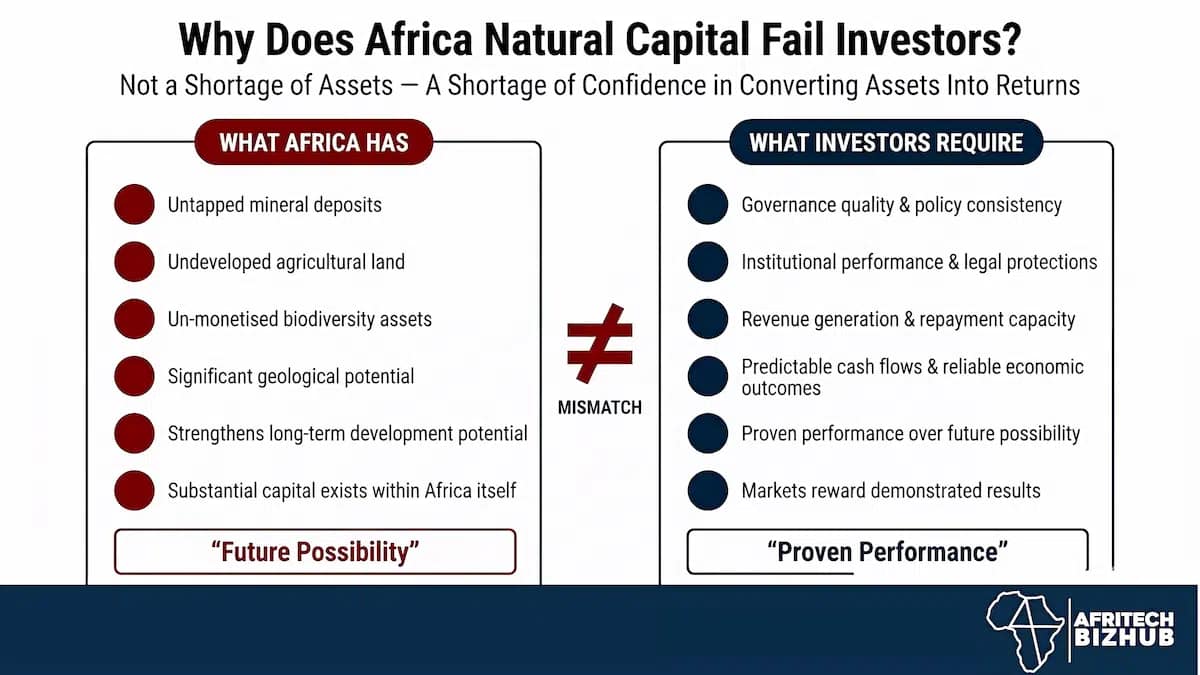
The challenge facing Africa natural capital is not a shortage of assets.
It is a shortage of confidence.
Investors can see the minerals, farmland, forests, energy reserves, and biodiversity.
What they remain less certain about is whether those assets can consistently generate revenue, withstand policy changes, and support repayment over time.
Investors rarely provide capital based on geological potential alone.
They assess governance quality, policy consistency, institutional performance, legal protections, revenue generation, and repayment capacity.
Natural resources become valuable to financial markets only when they generate predictable cash flows and reliable economic outcomes.
Untapped mineral deposits, undeveloped agricultural land, or unmonetised biodiversity assets may strengthen long-term potential, but they do not automatically reduce financing risk.
Markets reward proven performance more than future possibility.
How Do Borrowing Costs Hurt Economic Growth?
High borrowing costs do more than strain government budgets.
They quietly determine how quickly countries can build infrastructure, expand energy access, strengthen industrial capacity, and modernise public services.
When financing becomes expensive, governments face narrower policy options and slower implementation capacity.
The consequences extend beyond the public sector.
Businesses often borrow within the same economic environment shaped by sovereign risk perceptions.
Elevated borrowing costs can limit investment, reduce expansion plans, delay industrial projects, and weaken job creation.
Resource wealth loses much of its economic value when the cost of financing remains persistently high.
Economic growth becomes harder to sustain when access to capital remains expensive despite the presence of substantial natural wealth.
Why Are African Resources Not Creating Wealth?
African resources generate wealth when extraction, processing, value addition, taxation, and reinvestment operate effectively as part of a broader economic system.
Resource abundance alone does not guarantee those outcomes.
Several countries possess valuable assets but continue exporting raw materials while importing higher-value finished products.
The uncomfortable reality is that resource extraction alone rarely creates national wealth.
Value is captured where processing, financing, manufacturing, and market access exist.
The gap between resources and wealth often reflects institutional capacity rather than geological limitations.
Countries that capture more value locally through processing, manufacturing, infrastructure development, and stronger fiscal systems are generally better positioned to convert resource endowments into broader economic gains.
Wealth creation depends on what happens after resources are discovered, not simply on the discovery itself.
How Does Investment Risk Limit Capital Access?
Investment risk remains one of the most important variables influencing capital flows into African markets.
Political uncertainty, currency volatility, debt sustainability concerns, regulatory unpredictability, and governance challenges continue shaping investor assessments across several countries.
Institutions such as the African Development Bank have increasingly argued that Africa’s financing challenge is closely linked to risk perception and risk pricing rather than resource scarcity.
Efforts to expand guarantee mechanisms, improve project preparation, strengthen governance frameworks, and develop investable asset pipelines reflect a growing recognition that reducing perceived risk is often as important as attracting new capital.
Money rarely avoids opportunity.
It avoids uncertainty. For many African economies, reducing risk may prove more important than raising additional capital.
Can National Capital Strengthen the African Economy?
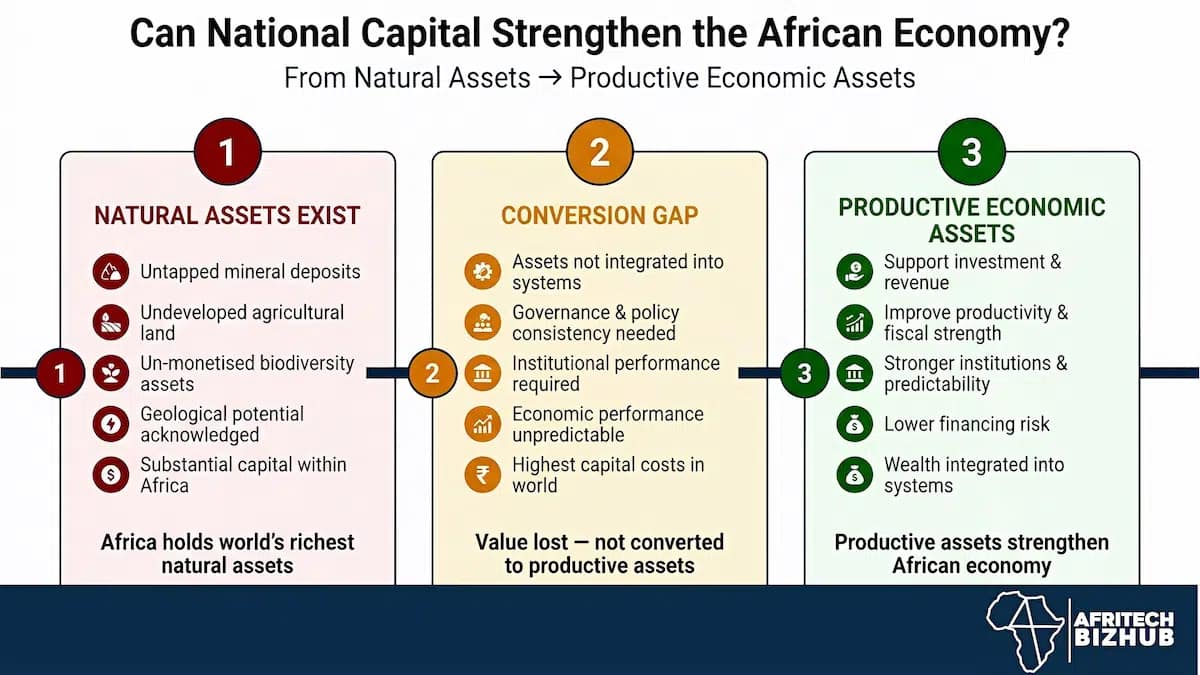
National capital can strengthen the African economy when natural assets are converted into productive economic assets capable of supporting investment, revenue generation, and long-term development.
The objective is not simply to measure resource wealth.
It is to transform natural assets into investable assets.
That requires stronger institutions, more effective governance, deeper capital markets, improved project preparation, and clearer pathways for monetising natural wealth without undermining long-term sustainability.
The real test for Africa natural capital lies ahead.
Markets already recognise the continent’s resource abundance.
What remains unresolved is whether governments, institutions, and financial systems can convert that abundance into confidence.
Africa’s borrowing challenge is no longer a resource problem.
It is a trust problem.
Until confidence improves, the continent may continue holding some of the world’s richest natural assets while paying some of the world’s highest prices for capital.


Recent Comments