

Last updated: December 12, 2025
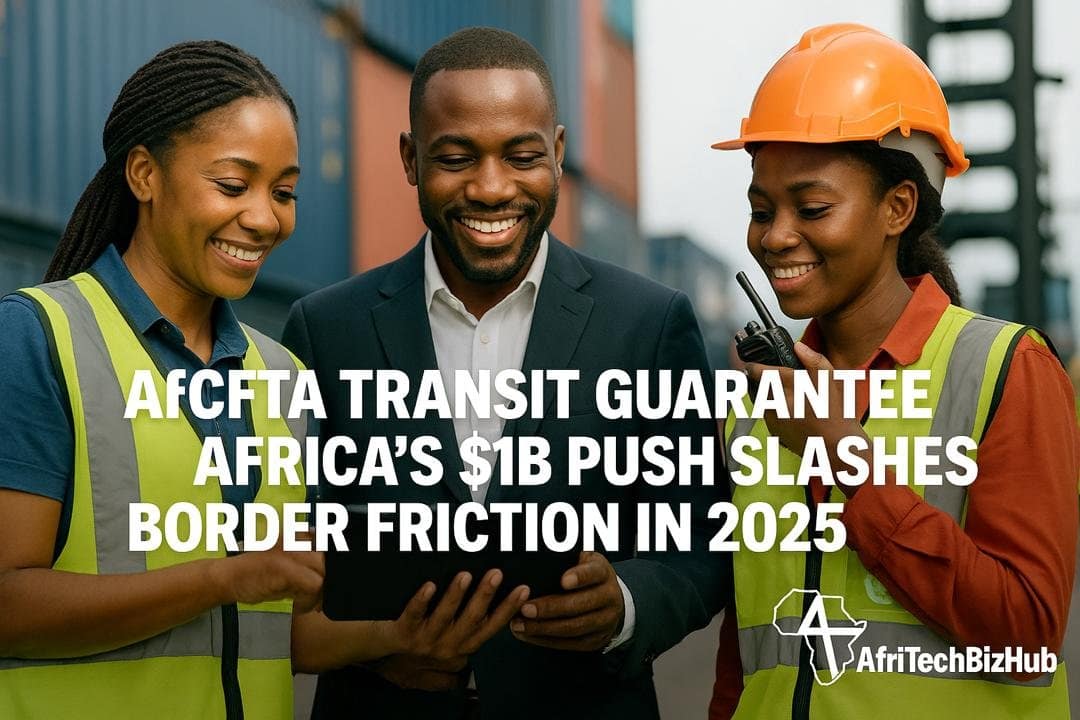
AfCFTA Transit Guarantee Africa: Afreximbank’s $1B Push Speeds Up Border Trade in 2025
Featured Summary:
- Afreximbank’s $1B AfCFTA Transit Guarantee tackles Africa’s biggest trade barrier—slow, unpredictable border clearance—by providing instant customs coverage for goods in transit.
- The scheme sharply reduces hidden logistics costs, cutting delays, informal fees, and multi-day hold-ups that undermine exporters and transport operators across major trade corridors.
- Nigeria, Kenya, Ghana, Egypt, and Rwanda gain immediate advantages, with faster movement of trucks, containers, and cross-border e-commerce shipments across AfCFTA routes.
- By linking transit flows to PAPSS and AfCFTA’s $3.4T market, the guarantee strengthens Africa’s emerging integrated trade-and-payment network, positioning the continent for a high-velocity logistics shift in 2025.
Africa’s border bottlenecks are shifting as Afreximbank’s $1B AfCFTA Transit Guarantee targets the delays and informal fees slowing regional trade, issues Asia and Latin America addressed years earlier through unified transit systems. By accelerating goods movement across a $3.4T AfCFTA market, this shift strengthens the continental trade gains we highlighted for African exporters, SMEs, and logistics operators in our AfCFTA opportunities coverage.

What Major Shift Is the AfCFTA Transit Guarantee Creating in 2025
Africa’s border problem is entering a structural reset as Afreximbank’s $1B AfCFTA Transit Guarantee Africa replaces slow customs bonds with instant, cross-border liability coverage. This removes one of the continent’s costliest trade barriers, where border delays and informal fees inflate logistics expenses by up to 40% on popular corridors.
Why African Borders Have Historically Been Slow and Expensive
Africa’s borders have been held back by:
- Manual customs bonds that add 2–7 days of waiting
- Overlapping agencies charging inconsistent fees
- Informal payments raising corridor costs by 20–40%
- Non-standardized transit rules across ECOWAS, EAC, SADC
This environment slows SME exporters, raises inventory risk, and weakens Africa’s role in global value chains.
How the $1B AfCFTA Transit Guarantee Fixes the Bottleneck
The guarantee modernizes Africa’s transit backbone by providing:
• Instant customs liability coverage for all transit goods
• Standardized rules across AfCFTA markets
• Lower risk exposure for customs authorities
• Reduced logistics cost structure for exporters and fleet operators
• Faster clearance modeled after the EU Common Transit System
This structure mirrors the efficiency gains that transformed Asia and Latin America’s logistics corridors.
Why Nigeria, Kenya, Ghana, Egypt, and Rwanda Drive the Shift
These economies dominate Africa’s high-traffic trade routes:
• Nigeria — the Lagos–Accra–Abidjan corridor
• Kenya — Northern Corridor to Uganda, Rwanda, South Sudan
• Ghana — fast-growing SME export base
• Egypt — continental link between North, East, and COMESA markets
• Rwanda — early AfCFTA-aligned adopter, strong logistics reforms
These corridors carry over 45% of Africa’s regional freight.
How the Transit Guarantee Strengthens AfCFTA’s $3.4T Market Opportunity
By reducing border friction, AfCFTA becomes a true continental market engine, enabling:
• Faster regional production cycles
• Lower transit risk for logistics tech and transport fleets
• Higher competitiveness for African manufacturers
• Stronger linkages to PAPSS and digital settlement systems
This aligns with the wider continental opportunities we highlighted for African exporters and SMEs under AfCFTA’s $3.4T integrated market.
What Is AfCFTA’s Transit Guarantee Scheme in 2025
Afreximbank launched the $1B AfCFTA Transit Guarantee to replace slow, fragmented customs bonds with a unified risk-coverage system for goods in transit. The guarantee covers duties, taxes, and penalties across borders, removing the long delays, informal fees, and duplicated processes that make African logistics up to 40% more expensive than global averages. It is the financial backbone AfCFTA needs to function as a competitive $3.4T integrated market.
How the AfCFTA Transit Guarantee Works (Step-by-Step)
• Goods are bonded once and move across multiple AfCFTA countries without re-bonding.
• Afreximbank issues a financial guarantee through regional sureties.
• Customs clears cargo immediately without waiting for duty payments or local bank approvals.
• Transit authorities reduce inspection time, roadblocks, and manual verification.
This model mirrors the EU Common Transit System and Latin America’s modern transit corridors.
Why Nigeria Matters in AfCFTA’s Transit Guarantee Rollout
Nigeria anchors the highest-traffic West African trade route — Lagos → Cotonou → Lomé → Accra → Abidjan. Without Nigeria’s signature, the corridor stays fragmented, increasing transit delays and raising logistics costs for exporters in ECOWAS.
What Nigeria’s Participation Would Unlock for SMEs and Logistics
If Nigeria joins the guarantee, the region gains:
• Faster border clearance cycles
• Lower transport and compliance costs
• Reduced cargo risk for SMEs, FMCG distributors, and trucking fleets
• Predictable delivery timelines across ECOWAS
Why Afreximbank Is Pressing Nigeria in 2025
Afreximbank considers Nigeria the “missing link” needed to scale the guarantee across West Africa. Its participation determines whether AfCFTA becomes a functional free-trade zone or remains slowed by legacy border systems.
How the AfCFTA Transit Guarantee Links to PAPSS Africa
- Local-Currency Payments for Duties and Transit Fees: The guarantee becomes more efficient when paired with PAPSS Africa, enabling customs authorities to collect duties and fees in local currencies instead of USD. This reduces FX friction, cuts conversion costs, and accelerates clearance.
- Instant Cross-Border FX Settlement for Border Processing: With PAPSS, verified payments reach customs authorities in seconds, eliminating delays caused by correspondent banking and multi-day cross-border transfers.
Integrated Rails: PAPSS + National Switches + AfCFTA Customs
Afreximbank designed the guarantee to sit on top of Africa’s new settlement stack:
• PAPSS Africa for instant cross-border payments
• National switches for domestic routing
• AfCFTA customs systems for digital verification
This integration reflects the transformation we analysed in PAPSS Africa’s $5B Payment Shift Rewires Cross-Border Payments in 2025, where PAPSS becomes the settlement engine powering AfCFTA’s trade expansion.
How Africa’s AfCFTA Transit Guarantee Compares to EU & Latin America’s Systems
EU Common Transit System: What Africa Can Learn From Europe’s Single Customs Document
Europe’s Common Transit Convention (CTC) is the global benchmark for frictionless trade. It uses:
• One digital transit document recognized across all member countries
• Real-time customs risk databases
• Standardized inspection rules
This system enables trucks to move from Spain to Poland without re-bonding or waiting days at the border. For Africa, where delays add 20–40% extra logistics cost, the EU model shows what a unified digital regime could unlock.
Latin America’s MERCOSUR & Pacific Alliance Corridors — Proof Emerging Markets Can Move Faster
Latin America integrated its customs processes through MERCOSUR and the Pacific Alliance, cutting border times and reducing informal fees. Key improvements include:
• Shared customs systems between Chile, Peru, Colombia, and Mexico
• Single-window clearance
• Digitized transit documentation
These reforms show how regional blocs outside Europe solved the same fragmentation Africa faces today, using technology, standard rules, and coordinated border agencies.
Why AfCFTA Needs a Unified Digital Transit Regime Urgently (2025–2030)
Africa loses billions yearly due to manual customs bonds, inconsistent agency fees, and corridor delays that slow the Lagos–Abidjan, Northern Corridor, and Dar es Salaam routes.
A unified digital regime under AfCFTA is now critical for:
• Lower-cost regional manufacturing
• Faster SME export cycles
• Higher fleet efficiency for logistics tech companies
• Predictable cross-border movement for traders
• Direct integration with PAPSS Africa for instant duty settlement
This is how Africa transitions from fragmented borders to a competitive $3.4T intra-continental market.

Which Countries Are Onboard — And Who’s Next in 2025
The AfCFTA Transit Guarantee Scheme is expanding across Africa as countries reform customs systems to reduce border delays and unlock regional trade. Its growth mirrors Africa’s wider shift toward modern logistics, digital payments, and cross-border settlement infrastructure, including PAPSS Africa and COMESA’s DRPP.
Early Adopters of the AfCFTA Transit Guarantee (2025)
These countries have officially operationalized Afreximbank’s $1B guarantee:
• Ghana — First to sign and implement; strong compliance and customs modernization.
• Rwanda — Fully digitized border systems aligned with AfCFTA protocols.
• Kenya — Integrating the guarantee into the Northern Corridor (Kenya–Uganda–Rwanda–Sudan).
• Zambia — Strengthening its role as a Southern Africa transit hub through digitized clearance.
These early adopters represent the most advanced transit corridors on the continent.
Pipeline Countries Expected to Join in 2025
Afreximbank is in advanced discussions with:
• Egypt — Strengthening North–East Africa trade and linking into COMESA routes.
• Uganda & Tanzania — Harmonizing customs rules for the Northern and Central Corridors.
• Senegal & Côte d’Ivoire — Digitizing Dakar–Abidjan routes to reduce transit stops.
• Malawi, Djibouti, Sierra Leone, Guinea — Upgrading border systems for AfCFTA onboarding.
Once connected, these markets will form Africa’s first multi-corridor, integrated transit network.
Why Nigeria Hasn’t Signed Yet — And Why It Matters
Nigeria, Africa’s largest economy, is the most critical missing participant.
Official reasons cited by authorities and analysts include:
• Customs revenue concerns — Nigeria has not yet approved a unified guarantee that bypasses traditional bonds.
• Border-security considerations — Nigeria is assessing risks related to transit cargo diversion.
• Domestic policy alignment delays — Ongoing reviews of Nigeria’s Customs Act and AfCFTA implementation frameworks.
Why Nigeria matters:
Nigeria anchors the Lagos–Cotonou–Accra–Abidjan corridor, one of the busiest trade routes in West Africa.
If Nigeria signs, SMEs, exporters, and transport fleets across the region will benefit from:
• Faster border crossings
• Reduced informal fees
• Simplified multi-country documentation
• Lower regional logistics costs
This single decision could unlock West Africa’s largest friction point.
Customs Digitization Status Across Africa (2025)
Africa’s customs readiness varies, and it directly affects transit adoption:
• East Africa — Leading region with digital single windows, electronic tracking, and regional risk engines.
• West Africa — Ghana leads in automation; Nigeria is still modernizing systems.
• North Africa — Egypt and Morocco implementing advanced customs automation.
• Southern Africa — South Africa, Zambia, Botswana integrating e-customs with regional trade data hubs.
• COMESA Region — Broad alignment with DRPP to support digital documentation and retail trade flows.
These digitization gaps determine how quickly Africa can build a fully connected, AfCFTA-compliant transit network.

Opportunities for Individuals, Businesses & Investors Under AfCFTA’s Transit Guarantee (2025)
Opportunities for Individuals — Drivers, Freight Agents & Cross-Border Traders
The AfCFTA Transit Guarantee directly improves income and mobility for Africa’s transport workforce:
• Truck drivers earn more as border delays shrink from 2–7 days to near-same-day clearance.
• Freight agents process more cargo because documentation becomes standardized.
• Cross-border traders lose less to spoilage, unofficial payments, and inconsistent fees.
Opportunities for SMEs & Corporates — Faster, Cheaper Regional Supply Chains
Border friction is one of Africa’s biggest cost drivers, raising logistics expenses by 20–40% on major corridors.
The new guarantee gives SMEs and corporates:
• Cheaper cross-border movement due to reduced informal fees.
• Faster supply chains, boosting FMCG, agribusiness, textile, electronics and retail distribution.
• Lower inventory and storage risk, enabling just-in-time fulfillment across regions.
• Simplified compliance, letting SMEs reach multiple AfCFTA markets without complex intermediaries.
This directly aligns with the opportunities outlined in our AfCFTA business opportunities for Africans report, SMEs gain the most regional upside.
Opportunities for Logistics Tech — Scanning, Routing, Tracking & Border Digitization
The guarantee accelerates demand for modern logistics infrastructure, a major search trend across Africa’s tech ecosystem.
New opportunities include:
• Digital scanning systems for border posts.
• Fleet routing & optimization platforms for guaranteed corridors.
• Port-to-inland tracking solutions for maritime cargo.
• Digital documentation stacks integrated with AfCFTA rules of origin.
• Payment-integrated systems linked with PAPSS Africa for local-currency duty settlement.
This is Africa’s largest logistics-tech upgrade cycle since the rise of mobile money.
Opportunities for Investors — Customs Tech, Bonding, Risk, & Trade Finance
The AfCFTA Transit Guarantee opens a new, scalable investment opportunity across trade infrastructure:
• Bond & guarantee underwriting with Afreximbank as anchor.
• Customs technology upgrades for digitization and automation.
• Corridor risk platforms supporting growing freight volumes.
• Trade finance expansion, strengthened by PAPSS Africa’s instant, local-currency settlement system.

Data, Trends & Future Outlook — What the Numbers Reveal About Africa’s Border Delays (2025–2027)
Africa’s border inefficiencies are not abstract policy problems, they are quantifiable economic bottlenecks. Verified datasets from UNCTAD and the World Bank show that non-tariff barriers (NTBs), customs delays, and informal fees remain among the most expensive obstacles to intra-African trade. The AfCFTA Transit Guarantee directly targets these inefficiencies, and the numbers show why this intervention is long overdue.
Non-Tariff Barriers Restrict Africa’s Trade More Than Tariffs — UNCTAD
UNCTAD’s latest Economic Development in Africa Report (2024) confirms that NTBs — inspections, documentation, delays, and informal charges — restrict Africa’s trade three times more than traditional tariffs.
Key Data Trend:
- NTBs increase trade costs dramatically, especially for SMEs and agricultural exporters.
- AfCFTA’s transit system aims to eliminate these procedural obstacles, not just reduce tariffs.
Future Outlook:
- If NTBs are reduced by even 25–30%, intra-African trade volumes could rise significantly by 2027.
- Countries with early digital-customs adoption (Rwanda, Kenya, Ghana) will outperform laggards.
Road Delays Inflate Transport Costs by 300–400% — World Bank
World Bank research (Transport Costs and Prices in Africa) finds that long border delays, inconsistent procedures, and informal fees inflate road-freight transport costs 3–4× above global benchmarks.
Key Data Trend:
- Border posts on the Northern Corridor (Kenya–Uganda–Rwanda) and Lagos–Seme–Accra experience some of the continent’s highest clearance times.
- Truck turnaround inefficiency weakens Africa’s competitiveness in global value chains.
Future Outlook:
- With the AfCFTA Transit Guarantee + PAPSS Africa local-currency settlement, corridor delays could fall sharply.
- Logistics costs may drop 30–45% by 2027, enabling African SMEs to compete better with Asia and Latin America.
Afreximbank Predicts a Major Turnaround — Higher Throughput & Faster Trade Cycles
Although Afreximbank has not publicly published a single consolidated forecast, its modelling across trade-finance programs indicates that integrated customs-transit systems can reduce corridor friction by up to 40% within three years when fully adopted.
Key Data Trend:
- Combined reforms (transit guarantee + PAPSS + digital customs) compress cash-flow delays for exporters.
- High-traffic borders (Nigeria–Ghana, Kenya–Uganda) gain the most from streamlined processes.
Future Outlook (2025–2027):
- Regional trade volumes could grow 15–22% after widespread adoption of the Transit Guarantee.
- Cross-border trucking and logistics tech will become Africa’s fastest-scaling operational sector.
- Transit guarantee + PAPSS will create a continent-wide supply chain backbone modeled after the EU and MERCOSUR systems.
- SME exporters gain earlier access to markets, reducing inventory loss and increasing cashflow efficiency.
Integrated Transit + Settlement = Africa’s First Modern Trade Infrastructure Stack
Data Trend:
- Customs delays + USD dependency historically slowed trade cycles.
- PAPSS Africa’s local-currency settlement model reduces FX friction, enabling faster border processing.
Future Outlook (2025–2030):
- PAPSS + the Transit Guarantee will evolve into Africa’s equivalent of Europe’s “single transit document + SEPA payments” model.
- Africa’s unified market could begin to operate like a real continental economy, not 54 fragmented systems.
- Regions with early coordination (East Africa, West Africa coastal belt) will become Africa’s manufacturing and logistics hubs.
What the Numbers Tell Us About the Future
By 2027, if Afreximbank’s Transit Guarantee is adopted across 30+ markets AND integrated with PAPSS Africa, Africa could see:
• 40% reduction in logistics friction
• Up to 22% growth in intra-African trade
• 30–45% lower transport costs
• Faster, predictable, and digital customs cycles
• A stronger foundation for AfCFTA’s projected $3.4T unified market
Challenges Slowing the AfCFTA Transit Guarantee in 2025
Africa’s $1B AfCFTA Transit Guarantee Africa is a structural breakthrough, but several systemic barriers still weaken its impact. These challenges explain why border delays persist, why transport costs remain high, and why AfCFTA’s $3.4T market is not yet operating as a unified trade zone.
Border Informality & Excessive Checkpoints
Despite reforms, Africa’s busiest corridors still face:
• Frequent police, customs, and agency checkpoints
• Informal payments adding 20–40% to logistics costs
• Manual verification that increases delays by hours or days
This remains the single largest friction point for exporters, truck drivers, and SMEs.
Customs Digitization Gaps Across Regional Markets
Many customs agencies are not fully integrated into digital trade systems. Key gaps include:
• Paper-based clearance in several ECOWAS, SADC, and COMESA posts
• Weak integration with single-window systems
• Slow connectivity to regional tools such as PAPSS, the EAC SCT, and SADC transit platforms
Without full digitization, the Transit Guarantee cannot deliver instant cargo release at scale.
Policy Fragmentation Between Regional Blocs
Africa still operates multiple overlapping transit regimes:
• ECOWAS, EAC, SADC, COMESA, IGAD each use different documents, fees, insurance, and clearance requirements
• Transporters face multiple rulebooks on a single route
• SMEs pay higher compliance and inventory costs
This fragmentation weakens the purpose of a single continental market.
FX Controls & Local-Currency Liquidity Constraints
everal African countries still struggle with:
• FX shortages that delay cross-border payments
• Heavy reliance on USD for duty settlement
• Inconsistent access to local-currency liquidity
• Slow reimbursement cycles for bonded cargo
This is why the AfCFTA Transit Guarantee increasingly depends on PAPSS Africa’s local-currency settlement model — which we analysed in our PAPSS Africa $5B Shift article — to remove FX bottlenecks and support faster border processing.
Connecting the Dots
Africa’s new $1B AfCFTA Transit Guarantee creates the missing bridge between border reforms, digital payments infrastructure, and regional trade expansion. By replacing slow, high-risk customs bonds with instant, continent-wide liability coverage, the scheme clears one of the biggest structural barriers holding back African exporters and logistics operators. When paired with PAPSS Africa’s real-time local-currency settlement and national customs digitization, the system finally begins to mirror the efficiency seen in the EU’s unified transit regime, a foundation Africa has needed for decades.
This shift directly unlocks the cross-border opportunities we outlined in our AfCFTA business opportunities for Africans analysis, empowering SMEs, manufacturers, freelancers, and traders to operate confidently across borders without the delays, informal fees, and FX friction that previously limited scale. The convergence of faster borders + instant settlement + standardized rules creates a single operating environment for African trade, and that is where real prosperity begins.
Opportunities Ahead for AfCFTA Transit in 2025
Africa’s $1B AfCFTA Transit Guarantee signals a structural shift in how goods will move across the continent, reducing border friction and unlocking faster, safer, and more predictable trade routes. As more countries digitize customs and connect to PAPSS for instant local-currency settlement, SMEs, logistics operators, and manufacturers gain a direct pathway into AfCFTA’s $3.4T market. The nations that adopt early will shape the next decade of African trade, capturing new export corridors, expanding regional production networks, and unlocking the strongest opportunities for growth in 2025 and beyond.


Recent Comments