

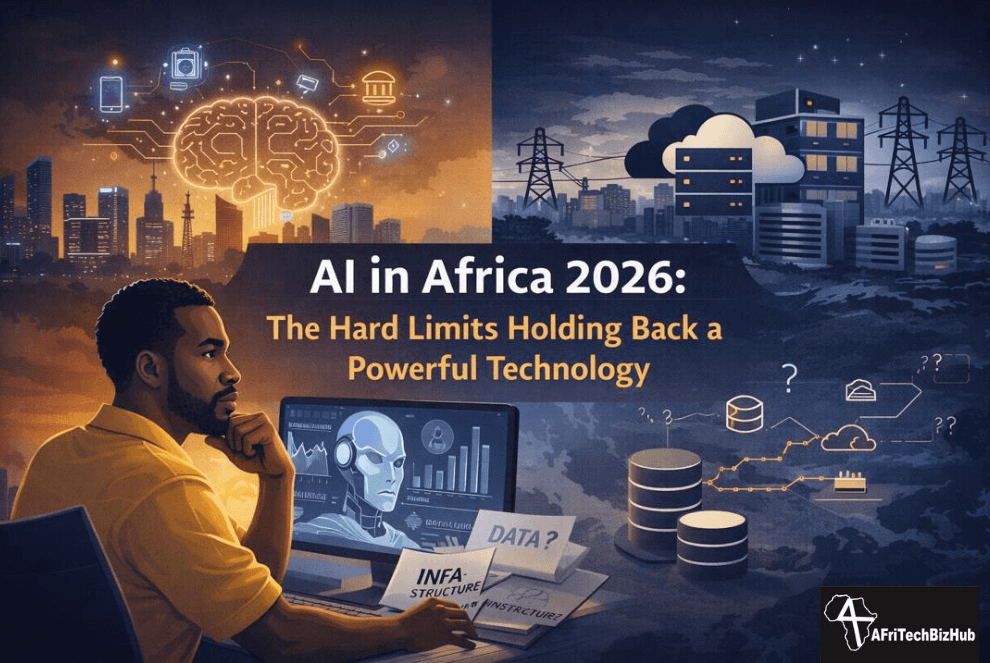
Why data scarcity, power gaps, and cloud dependence now matter more than AI talent
Featured Summary:
• AI is already being used across Africa in 2026, but weak power, thin local data, and cloud dependence cap how far it can go.
• Most AI in Africa startups are wrappers, not builders. They resell foreign models and infrastructure. That limits control, defensibility, and long-term value.
• Governments and large enterprises are the real AI buyers, adopting quietly through procurement and automation while startups struggle to scale.
• The real gap is AI work, not AI unicorns. Operational AI jobs that could employ millions remain underbuilt and underfunded.
AI in Africa is already embedded across Africa’s economy, banks deploy it, telcos optimize with it, governments procure it quietly. What changed by 2026 is not adoption, but control.
Who owns the systems. Who captures value. And where structural limits have stopped being theoretical. Africa is not “behind” on AI. The harder truth is that the ceiling is now visible, and ignoring it is becoming expensive.

Where AI Is Actually Being Used in Africa
AI in Africa use is concentrated, not broad. Banks deploy it for fraud detection, credit scoring, and transaction monitoring. Telecoms use it to manage churn, price data, and optimize networks.
Governments apply it quietly, identity systems, revenue leakage, border control, security analytics.
The public conversation still circles consumer apps and demos. The money does not. Enterprise AI dominates budgets because regulated institutions have data, mandates, and tolerance for slow returns.
Most AI in Africa value created today sits inside regulated institutions, not startups, and that concentration is structural, not accidental.
The Startup Reality: Built Models vs. Wrapped Infrastructure
Africa’s AI startup field has split cleanly.
A narrow group is trying to build models under tight data, compute, and power constraints. A far larger group is wrapping foreign APIs, localising interfaces, and selling proximity as innovation. Both can generate revenue. Only one builds leverage.
Calling API wrappers “AI companies” flatters the ecosystem, but it misleads founders about where defensible value actually sits.
This is where stories sound strong, and balance sheets quietly disagree.
The Backbone Nobody Controls: Data, Power, and Cloud Dependence
This is the constraint most AI conversations avoid.
Across Africa, AI systems still run on foreign cloud infrastructure, imported compute, fragile power grids, and data pipelines governed elsewhere. Talent exists. Ambition exists. Leverage does not.
Until storage, power reliability, and compute access shift closer to home, AI progress will keep stalling at scale. Many will argue otherwise. Procurement records are less optimistic.
Governments and Enterprises Are Moving Faster Than Startups
The fastest AI in Africa adopters are not founders. They are procurement offices.
Governments acquire AI through tenders. Banks embed it via vendors. Large enterprises deploy quietly, inside existing systems. No launch posts. No demo days.
Startups wait for visibility. Institutions sign contracts.
The most consequential AI in Africa deployment rarely appear on startup blogs, pitch decks, or conference stages.
That gap matters. It explains why adoption looks fast while startup revenues lag, and why funding charts miss where decisions are actually made.

The Underserved Layer: AI Work, Not AI Unicorns
AI in Africa biggest opportunity is not ownership. It is work.
Annotation. Model training. QA. Localization. Monitoring. Uncelebrated roles. Repeating demand. Real paychecks.
Founders chase unicorn narratives. Labor markets absorb people.
AI work is scaling faster than AI ownership across Africa, and policy still behaves as if the opposite is true.
This layer hires more people than venture-backed AI ever will, and gets the least strategic attention.
Connecting the Dots: Where Africa’s AI Narrative Breaks From Reality
AI in Africa is not stalled by lack of ideas or talent. It is constrained by structure. The evidence is visible in spending patterns, not pitch decks.
According to reporting on Africa’s rising AI adoption in 2025, commercial banks across the continent are actively integrating AI into core operations like fraud monitoring, onboarding automation, and real-time analytics, showing where institutional demand for AI is growing fastest. Startup innovation exists, but it sits downstream of these buyers, not at the center of power or scale.
The disconnect is this: the ecosystem talks about innovation velocity, while the system runs on procurement cycles, infrastructure ownership, and long-term contracts.
Those forces decide who captures value. Until AI in Africa conversation shifts from startup narratives to control of data, power, compute, and purchasing authority, progress will continue, but on terms set elsewhere. That is not a prediction. It is already happening.
When Limits Became Operational
2026 will not be remembered as Africa’s AI breakthrough. It will be remembered as the year constraints moved from theory to execution.
The conversation is already shifting, from demos to deployment, from narratives to infrastructure, from optimism to leverage. That shift is uncomfortable, but necessary.
AI progress now depends less on ambition and more on who controls data, power, procurement, and systems. Everything else is noise.


Recent Comments