

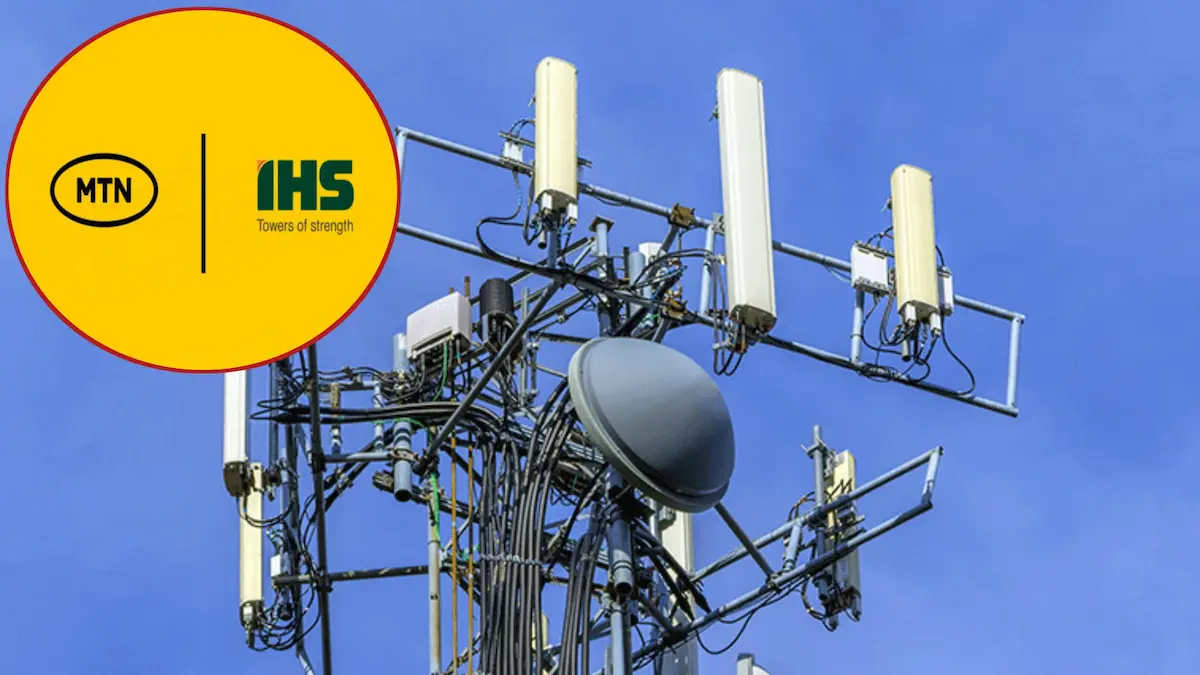
Featured Summary:
- MTN’s proposed $6.2 billion acquisition of IHS could reverse years of tower sales and reshape its African infrastructure ownership strategy
- IHS operates 28,599 towers, with Nigeria generating $359.4 million in third-quarter revenue, making it the company’s largest market
- IHS’s Nigerian revenue rose 34.1%, but energy costs, financing obligations and cash generation will remain critical to the acquisition’s returns
- MTN’s planned sell-down of up to 30% of IHS’s Nigerian business could open new investment opportunities for infrastructure funds and institutional investors
MTN Group is seeking to acquire IHS Holding in a transaction valued at approximately $6.2 billion, including debt and other enterprise-value components.
The proposed deal would give Africa’s largest mobile network operator by subscribers control of a major telecommunications tower business in which it already holds a 24.7% stake. Completion remains subject to outstanding transaction conditions.
MTN previously sold thousands of towers to IHS to raise capital for its mobile operations, retaining access to the infrastructure through long-term lease agreements. Acquiring IHS would bring those assets back under its control, together with the costs of operating and financing them.
The proposed acquisition comes as African telecom operators face continued spending on network expansion, electricity supply and equipment maintenance.
MTN expects greater control over infrastructure costs and cash flows from the transaction, but the financial returns will depend on the acquired business’s operating performance and financing requirements.
Its decision also raises a question for independent tower companies whose business depends on leasing infrastructure to mobile operators across Africa.
MTN’s Tower Acquisition Reverses Earlier Infrastructure Sales
MTN began selling towers to IHS in 2013, transferring 911 sites in Côte d’Ivoire for $141 million and 820 in Cameroon for $143 million. Further transactions in 2014 covered 550 towers in Rwanda for $48 million and 748 in Zambia for $57 million.
MTN retained network access through long-term leases, releasing capital from infrastructure ownership while continuing to operate its mobile services.
Nigeria accounted for the largest transfer. MTN agreed to place 9,132 towers into a joint venture with IHS, completing the first phase involving 4,154 sites in December 2014.
That transaction brought $451 million in cash and an equity interest valued at $370 million. The remaining sites followed in 2015, with MTN retaining access under an initial ten-year lease. A separate South African transaction involving approximately 5,700 towers and associated power assets took effect in May 2022.
The leasing arrangements continued to affect MTN’s finances. In August 2024, the company renegotiated its Nigerian tower contracts with IHS, extending them to December 2032 and reducing their exposure to dollar-denominated payments.
Most of the revised agreements were denominated in naira. MTN recognised R10.15 billion in additional lease liabilities and right-of-use assets following the modifications.
Under the February 2026 acquisition agreement, MTN would purchase the approximately 75.3% of IHS it does not already own for $8.50 per share.
The estimated $2.2 billion cash consideration comprises $1.1 billion from IHS’s existing cash and $1.1 billion funded through MTN’s liquidity and borrowings. The transaction’s approximately $6.2 billion enterprise valuation also reflects debt and other valuation components.
MTN expects the acquisition to increase group earnings and free cash flow by bringing IHS’s tower leasing income into its consolidated results. The company would also receive revenue from third-party operators using the infrastructure.
Its pro forma estimates indicate that net debt to EBITDA, excluding leases, would increase from 0.3 times to 0.8 times, below its medium-term ceiling of 1.0 times. These projections remain conditional on completion and management’s financial assumptions.
The acquisition would give MTN control of infrastructure it previously transferred to independent ownership, including the income generated by other network operators.
It would also bring IHS’s financing and capital expenditure requirements onto MTN’s balance sheet. Management’s expected improvement in cash generation will have to cover those commitments for the acquisition to deliver its projected financial benefits.
IHS’s Nigerian Tower Revenue Faces Energy and Financing Costs
Nigeria generated $359.4 million of IHS Holding’s $490.5 million third-quarter revenue from continuing operations, according to results released on November 10, 2026.
Nigerian revenue increased 34.1% year-on-year, including $50.8 million in organic growth and a $40.7 million benefit from currency translation. Higher diesel prices contributed to contractual power-related revenue, alongside additional equipment installations and lease amendments.
At September 30, IHS operated 28,599 towers serving 42,941 tenants across its portfolio, with a colocation rate of 1.50 tenants per tower. Nigeria recorded 497 tenant additions through colocation and 378 tenant losses. The company also reported 5,768 additional lease amendments, reflecting greater use of existing infrastructure by network operators.
Nigerian adjusted EBITDA increased 26.8% to $215 million, representing a margin of 59.8%. Power-generation expenses rose $38.8 million, staff costs increased $10 million and tower repairs and maintenance added $6.8 million.
Contractual power indexation and pass-through arrangements recovered part of the higher diesel expenses, leaving the company exposed to operating costs not covered by customer payments.
IHS reported group adjusted EBITDA of $282.7 million, up 8.1%, while cash from operations declined 5% to $246.7 million. Adjusted levered free cash flow increased 25.3% to $197.7 million, partly reflecting lower maintenance expenditure and reduced net interest and tax payments.
The company recorded a quarterly loss of $8.2 million, against a $147.4 million profit a year earlier, with higher administrative and financing expenses and losses from discontinued operations affecting the result.
Capital expenditure in Nigeria rose 31.8% to $54.1 million, including investment in fibre and network expansion. Group capital expenditure declined to $68.2 million following the disposal of Latin American operations. In September, IHS issued $200 million in senior notes carrying a 7.875% coupon to refinance debt maturing in 2026.
Nigeria remains IHS’s largest reported revenue market, supported by established tower locations and contracts with multiple network operators.
Its $215 million quarterly adjusted EBITDA provides substantial operating earnings, although electricity supply, site maintenance and network investment continue to require capital. The portfolio’s cash-generating capacity will be important to MTN’s expected returns from the acquisition.
Helios Towers is continuing its African infrastructure expansion, reporting 15,688 sites and 35,379 tenancies at September 30, 2026. The company plans more than $500 million in discretionary capital expenditure between 2026 and 2030, targeting over 42,000 tenancies and a tenancy ratio above 2.5.
Its investment plans remain focused on increasing the number of mobile operators using existing infrastructure and developing additional sites.
American Tower generated $427.9 million in third-quarter property revenue across its combined Africa and Asia-Pacific portfolio, up from $370.8 million a year earlier.
It expects approximately 12% growth in tenant billings across the region in 2026. The company’s global capital expenditure guidance stands at $1.77 billion to $1.88 billion, covering infrastructure investment across its international operations.
Financing remains part of Helios Towers’ expansion plans. In April 2026, the company issued $500 million in senior notes carrying a 6.75% coupon and maturing in 2031, replacing a term loan due in 2028.
It also arranged a $250 million undrawn credit facility to support its financing requirements. The refinancing extends the company’s funding arrangements as it pursues additional tenancy and infrastructure investment.
Nigeria could see another significant tower ownership transaction following MTN’s acquisition. The Federal Competition and Consumer Protection Commission granted conditional approval requiring MTN to sell down up to 30% of the Nigerian component of IHS at market prices over time. MTN disclosed the condition in its August 2026 interim results without announcing a buyer, agreed valuation or fixed disposal deadline.
The proposed disposal could attract infrastructure funds, institutional investors and other eligible buyers seeking an interest in Nigerian telecommunications assets.
Their participation would depend on the stake offered, the associated financing obligations and the terms of the transaction. MTN has not disclosed binding commitments from prospective investors.
Helios Towers’ expansion commitments and American Tower’s reported tenancy growth show that independent infrastructure ownership continues to attract investment.
MTN is pursuing control of an established tower portfolio, while its Nigerian regulatory conditions could return part of that business to outside shareholders. The next ownership decisions will establish whether other African mobile operators pursue similar acquisitions or maintain their existing leasing arrangements.
MTN’s IHS Deal Faces Its Next Investment Test
MTN is targeting completion of its IHS acquisition before the end of 2026, following shareholder approval and regulatory clearances in Nigeria and the Common Market for Eastern and Southern Africa (COMESA).
Its November 9 update indicated that further approvals remained outstanding. IHS must also meet specified cash and debt requirements before the transaction closes.
Nigeria’s ownership conditions present another pending transaction. MTN has disclosed plans to sell a 30% interest in IHS Nigeria to local investors on commercial terms, subject to market conditions.
No buyer or agreed valuation has been announced. The disposal would leave outside investors holding a substantial minority interest in the Nigerian tower business.
Helios Towers raised its 2026 discretionary capital expenditure guidance to $230 million–$245 million in November, with approximately 4,000 additional tenancies expected during the year.
The company also forecasts recurring free cash flow exceeding $235 million, maintaining investment in shared telecommunications infrastructure while increasing shareholder distributions.
MTN’s acquisition would bring tower operating earnings and capital requirements under the same ownership as its mobile network business. Its projected financial benefits remain dependent on completion, subsequent operating performance and financing costs.
Other African telecom operators have not announced comparable acquisitions on the same scale, leaving MTN’s transaction a company-specific investment decision rather than an established reversal of independent tower ownership.


Recent Comments