

Featured Summary:
- African instant-payment systems processed 71.4 billion transactions worth $1.828 trillion in 2025, according to AfricaNenda’s November 2026 report
- Mobile-money systems dominated transaction volumes, while interoperable networks connecting financial institutions accounted for most transaction value
- Banks, mobile-money operators and fintech companies are competing for merchant transactions, payment-processing income and business banking relationships
- Expanding payment infrastructure creates opportunities for financial institutions, with merchant adoption, transaction pricing and operating performance shaping returns
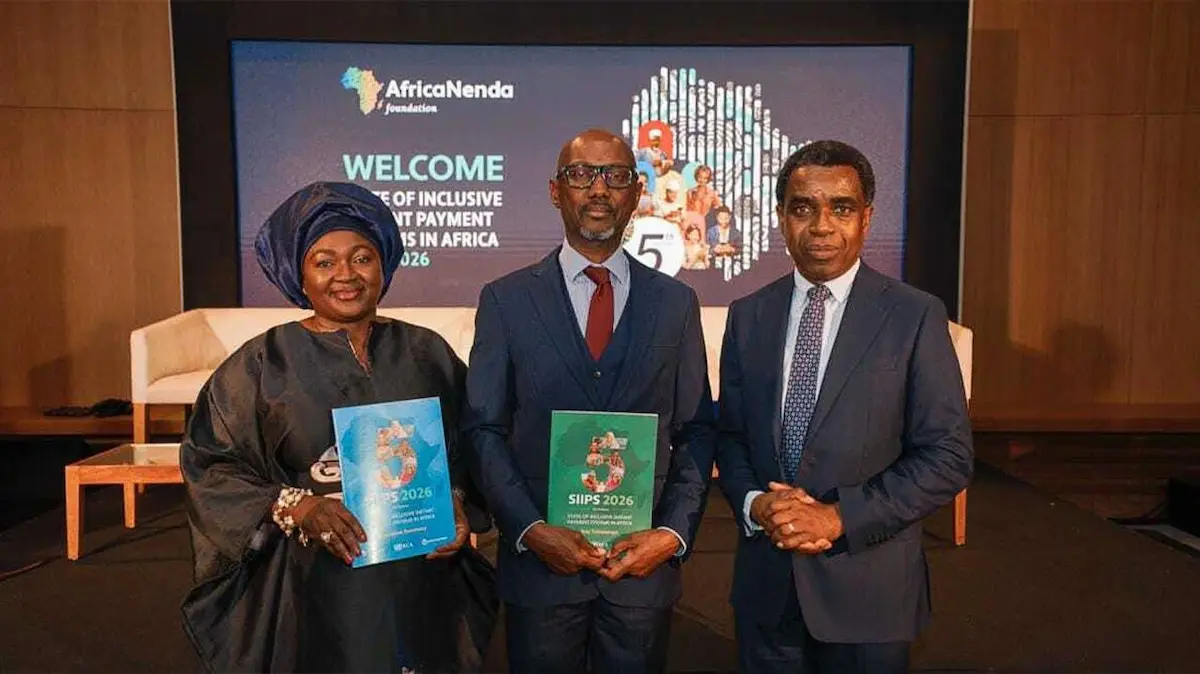
African instant-payment systems processed 71.4 billion transactions worth $1.828 trillion in 2025, according to AfricaNenda’s November 2026 State of Inclusive Instant Payment Systems in Africa report.
Transaction volumes increased 11% from 64.6 billion in 2024, while the average payment value fell from $31 to $26. Total transaction value declined 8% in US dollar terms, largely reflecting exchange-rate movements, but increased 7% when measured in local currencies.
AfricaNenda linked the higher transaction frequency to growing use of instant payments for smaller purchases and transfers, with the reported value covering consumer, business and other payment activity.
Mobile-money systems processed 52.48 billion transactions in 2025, representing 73% of the total. Bank-based systems handled 690 million transactions, up 42% from 480 million a year earlier, against 7% growth in mobile-money volumes.
Networks connecting different categories of financial institutions processed 18.25 billion transactions worth $1.22 trillion, accounting for approximately 67% of total payment value.
Their larger share of transaction value reflects a different payment mix from mobile-money networks, which continued to dominate transaction numbers.
MTN Mobile Money, Safaricom’s M-Pesa and Moniepoint are expanding merchant-payment services in markets where commercial banks also provide business accounts, payment acceptance and settlement facilities.
In Kenya, Safaricom’s Lipa na M-Pesa enables businesses to receive payments through merchant tills and Paybill accounts. Moniepoint provides Nigerian merchants with payment terminals and business banking services, while MTN operates merchant-payment products across its mobile-money markets.
MTN’s November 2026 trading update reported growth in active merchants and merchant-payment values. Banks compete for the same business transactions through acquiring services, settlement accounts and digital banking channels.
Mobile Money and Fintechs Compete for Merchant Payment Revenue
MTN Group processed $19.6 billion in merchant payments during the nine months ended September 2026, an increase of 16.5% in constant currency.
Active merchants grew 19.4% to 2.5 million, while total fintech transaction value reached $512.5 billion. Fintech revenue rose 12.7% in constant currency to R22.6 billion, covering mobile-money services, lending, remittances and other financial products.
Excluding Airtime Advance, mobile-money revenue increased 18.5%, supported by 32.4% growth in advanced-services revenue. Merchant-payment income was not separately reported.
Safaricom’s Lipa na M-Pesa processed KSh1.21 trillion in payments during the six months ended September 2026, an 18.5% increase, generating KSh5.08 billion in revenue, up 17.8%.
Pochi la Biashara handled KSh300.05 billion in transactions, nearly twice the value recorded a year earlier, with revenue rising 77.7% to KSh2.99 billion. Safaricom reported KSh19.36 billion in customer-to-business payment revenue, an increase of 10.1%.
The broader category includes merchant-payment services, with the individual product figures forming part of Safaricom’s reported business-payment activity.
Moniepoint Microfinance Bank processed ₦412 trillion across more than 14 billion transactions in 2025. The Nigerian company reported serving over six million active businesses and handling eight in every ten in-person payments nationwide.
Its network covers all 774 local government areas, supporting merchant collections through payment terminals, bank transfers and business accounts.
Moniepoint secured Mastercard and Visa acquiring licences in 2025, enabling it to process card transactions for additional businesses. Its disclosed processing volumes cover a broader range of transactions than merchant purchases alone.
Standard Bank processed R88 trillion in payments during the first half of 2026, while digital transaction volumes in South Africa increased 17%.
Group non-interest revenue grew 7%, supported by banking and transaction-related services. The bank reported a cost-to-income ratio of 49.3% for its banking operations and continued investment in payment technology.
Its payment volumes include corporate and other banking transactions, while the reported non-interest revenue covers activities beyond merchant acquiring.
Interoperable Networks Change Africa’s Payment Economics
AfricaNenda identified 39 operational instant-payment systems across Africa by July 2026, including 35 domestic and four regional networks.
Its November report found that 33 systems supported merchant payments, while 26 enabled transactions between different categories of financial institutions.
New systems entered operation in Liberia, Burundi, Guinea and Mauritania, expanding the number of countries with instant-payment infrastructure.
Banks, mobile-money operators and other licensed payment providers can participate in shared networks supporting transfers and merchant collections.
Nigeria’s National Payment Stack processed 26.55 million transactions worth ₦1.4 trillion across 48 participating institutions by August 2026, according to the Nigeria Inter-Bank Settlement System (NIBSS).
First Bank recorded the highest transaction volume, while Fidelity Bank led by value. GTBank, Sterling Bank, Access Bank and Moniepoint were among the participating institutions.
Built around ISO 20022 messaging standards, the platform supports account transfers and is designed to accommodate QR-code payments and additional services. NIBSS selected Transactility’s jPOS technology for its processing infrastructure.
The Central Bank of West African States (BCEAO) reported that 175 institutions had connected to its PI-SPI platform by October 2, 2026, providing instant-payment access to more than 38 million people across the eight West African Economic and Monetary Union countries.
Launched in September 2025, PI-SPI connects participating banks, electronic-money providers and other financial institutions. Its interoperable QR-code system supports merchant payments across participating providers.
The BCEAO also approved a common business API for payment integration, while microfinance institutions covered by regional supervision face a June 30, 2027 connection deadline.
In October 2026, the BCEAO introduced revised charges for person-to-person electronic-money transfers through PI-SPI. Domestic transfers within a daily cumulative threshold of CFA8,000 per user and participating institution are free, while amounts above that threshold may attract charges of up to 0.8%.
Recipients are not charged for incoming transfers. The published rules apply to transfers between individuals rather than merchant-acquiring services.
Cash Dependence and Payment Failures Threaten Africa’s Digital Growth
AfricaNenda surveyed 1,403 digital-payment users across 15 African markets in 2026 and found that 55% continued to use cash for approximately half their transactions. Only 33% relied on digital payments most of the time.
Respondents identified immediate payment completion, clear transaction confirmations and recipient verification among the factors influencing their confidence in digital payments. The findings reflect the experiences of surveyed users rather than all consumers or merchants across Africa.
Payment failures affected more than half of the respondents, including delayed transfers and payments sent to incorrect recipients. About one-third of those experiencing problems did not report them, often because they were unfamiliar with the complaint procedures.
Among respondents who lost money, 43% reduced their use of digital payments. Users who recovered their funds were more likely to increase their transaction activity.
Nigeria recorded ₦25.85 billion in electronic-payment fraud losses in 2025, compared with ₦52.26 billion in 2024, according to the Central Bank of Nigeria’s Payments System Vision 2028.
The central bank linked the reduction to stronger monitoring, regulatory controls and cooperation among financial institutions. A major internal fraud incident contributed to the higher 2024 figure. The reported losses covered several payment channels, including mobile banking, internet transactions and point-of-sale services.
AfricaNenda’s research identified differences in fraud-prevention capabilities across the payment industry. Payment service providers were adopting AI-based fraud-detection tools faster than operators of shared instant-payment systems.
The report identified recipient verification and faster dispute resolution among the measures needed to address customer losses and unsuccessful transactions.
These findings document operational weaknesses in the payment networks serving merchants, although they provide no company-level figures for the cost of resolving failed transactions.
Merchant Payment Profits Will Decide Africa’s Financial Winners
The Central Bank of West African States has given supervised microfinance institutions until June 30, 2027, to meet the connection requirements for its PI-SPI network.
Additional participants could extend interoperable payment services to smaller businesses across the West African Economic and Monetary Union.
Their connection status and the availability of merchant-payment services will provide evidence of how far the regional network has expanded beyond its existing participants.
Safaricom enters this period with reported revenue growth from Lipa na M-Pesa and Pochi la Biashara. MTN’s expanding merchant network and Moniepoint’s Nigerian processing operations demonstrate substantial payment activity, while Standard Bank competes through its transaction-banking services.
Safaricom’s product-level disclosures offer the clearest evidence of merchant-payment monetisation among the companies examined. The others report broader financial results that leave their merchant-specific earnings less visible.
Africa’s instant-payment networks have created more opportunities for financial institutions to compete for business transactions, but the reported results establish different levels of commercial progress.
Safaricom has demonstrated merchant-payment revenue growth, while comparable profitability figures remain unavailable for the other operators examined.
Their 2027 earnings disclosures will determine whether expanding merchant networks are generating sufficient returns to justify processing, technology and customer-service expenditure. Transaction growth has intensified the competition; merchant-payment profits will determine its financial winners.


Recent Comments