


Last updated: June 16, 2026
Featured Summary:
- Africa digital economy is expanding through recurring digital spending rather than one-time ownership.
- Mobile data, fintech fees, software access, subscriptions, and device financing are becoming permanent operating expenses.
- Digital participation is growing faster than income growth across many African markets.
- The next digital divide may emerge around affordability rather than access.
Africa digital economy spent the last decade solving access.
Connectivity expanded. Mobile money scaled.
Digital payments moved deeper into commerce.
Businesses digitised operations. Governments accelerated online service delivery.
The next constraint is becoming harder to ignore.
Participation increasingly depends on staying inside systems that charge continuously rather than occasionally.
Consumers and SMEs now spend repeatedly on connectivity, payment access, software, cloud services, subscriptions, transaction activity, and financed devices.
Growth remains strong.
A Mastercard-commissioned report projects Africa’s digital payments economy could reach $1.5 trillion by 2030, supported by expanding internet penetration and financial inclusion.
That projection measures scale. It does not automatically measure affordability.
The question is changing.
Not who gets connected.
Who can afford to remain connected.
Is Africa Digital Economy Creating Permanent Consumer Costs?
The original promise of digital expansion was simple: connect once and participate.
That operating logic is changing.
Digital participation increasingly behaves less like ownership and more like utility consumption.
Data renewals, transaction fees, software access, streaming services, cloud storage, app ecosystems, and installment-based devices now create continuous expenditure rather than occasional purchases.
That distinction matters because recurring costs change economic behaviour.
Ownership absorbs spending once and releases future cash flow.
Subscription and access models extend payment obligations indefinitely.
Digital expansion itself is not the problem.
The pressure appears when participation requirements rise faster than household purchasing power.
The strategic question for policymakers is becoming less about onboarding users and more about reducing the cost of staying active inside digital markets.
Why Is Africa’s Digital Economy Becoming More Expensive?
Lower friction did not eliminate monetisation.
It redistributed where monetisation happens.
Telecom operators earn from connectivity.
Payment providers earn from transactions.
Platforms earn from engagement.
Software providers earn from access.
Financial firms earn from repeated usage.
Consumers experience each charge individually.
Businesses experience them simultaneously.
That cumulative structure changes cost intensity across the economy.
Digital participation increasingly requires maintaining multiple service relationships rather than owning productive infrastructure outright.
Scale therefore creates a contradiction.
More digital activity expands economic opportunity while multiplying the number of institutions extracting value from the same customer relationship.
Growth does not automatically reduce cost pressure.
That assumption increasingly deserves scrutiny.
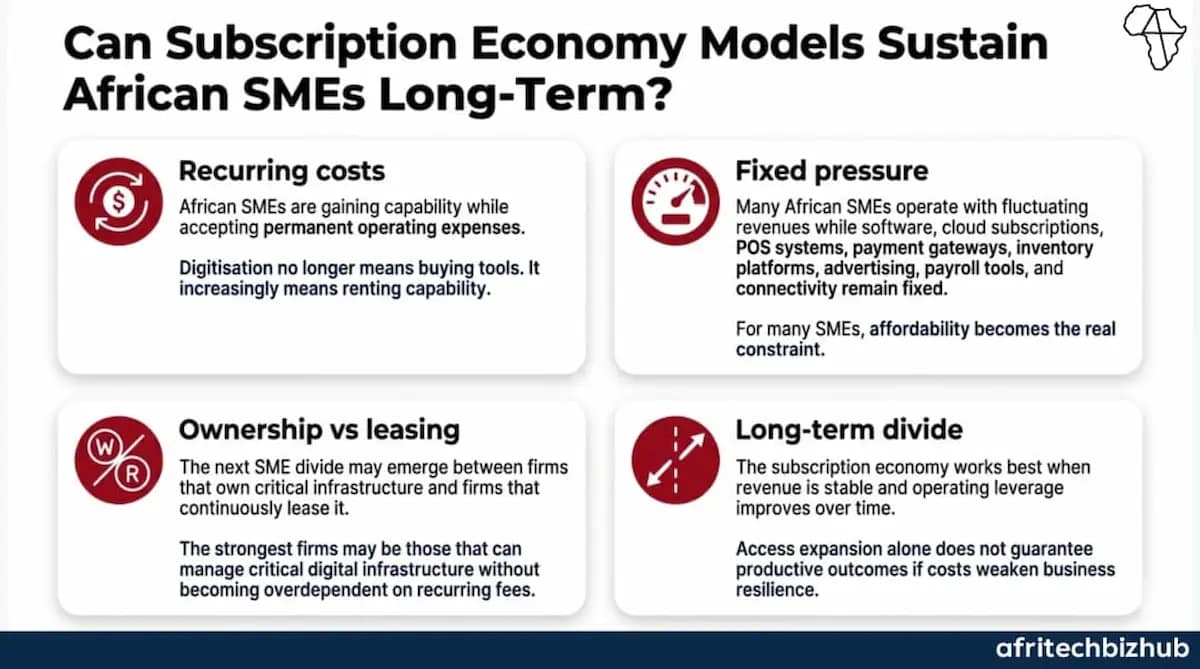
Can Subscription Models Sustain African SMEs Long-Term?
Digital adoption is increasing business capability while changing business economics.
Many SMEs previously purchased assets and extracted value over time.
Digital operations increasingly require renting capability.
Software licences renew. Cloud infrastructure renews.
POS systems renew.
Connectivity renews.
Payment access renews. Marketing spend renews.
Revenue does not always renew at the same pace.
That imbalance creates operating pressure.
Businesses with unstable cash cycles absorb fixed digital obligations more aggressively than firms with predictable revenue.
Research from the World Bank continues showing that digital access supports inclusion and business participation, but access expansion alone does not guarantee stronger productivity outcomes if affordability weakens over time.
The next SME divide may not emerge between online and offline firms.
It may emerge between firms that own critical capabilities and firms that continuously lease them.
Will Fintech Growth Create Access Without Ownership?
Fintech solved important frictions.
Payments became faster.
Financial access widened.
Merchant participation improved.
Cross-border transactions became easier.
The commercial model evolved alongside that success.
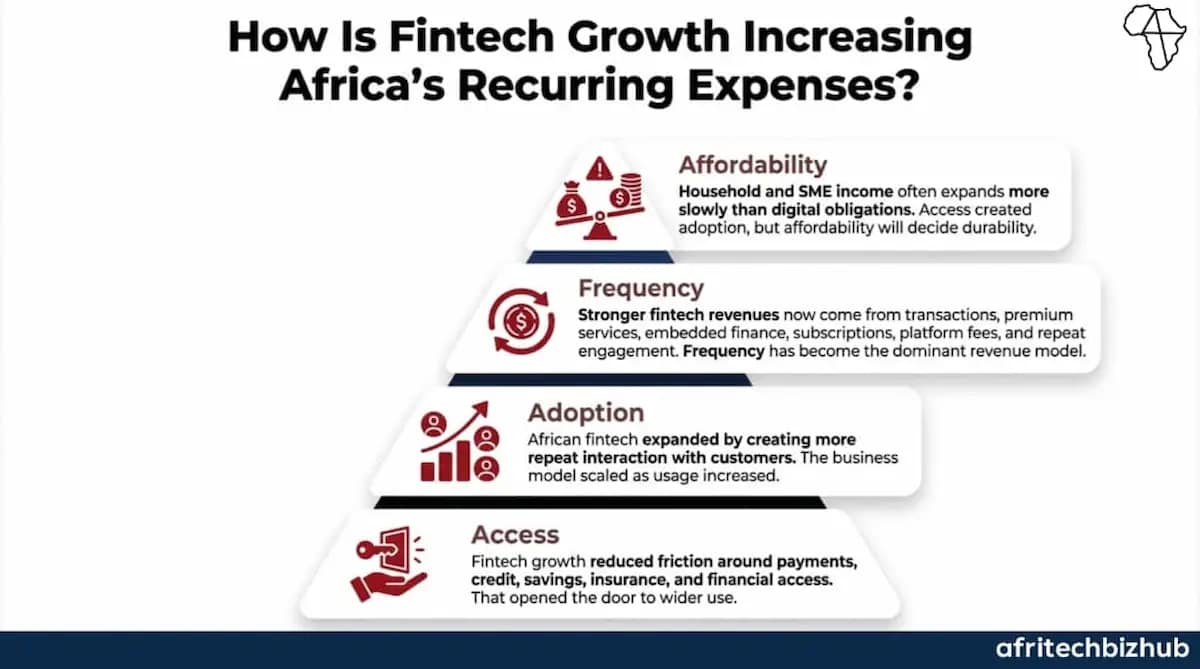
The strongest platforms increasingly monetise frequency.
Transaction activity, premium services, embedded finance, subscriptions, software access, merchant services, and repeat engagement increasingly determine profitability.
That model scales efficiently.
It also changes incentives.
Digital ecosystems benefit when users remain connected longer, transact more often, and depend more deeply on platform infrastructure.
There is nothing inherently problematic about recurring revenue.
The pressure emerges when household income and SME margins expand more slowly than digital obligations.
Africa digital economy may therefore be entering a harder phase.
Access created adoption.
Affordability will determine durability.
Read: African AI Push: AISCA Steps In to Close the Continent’s Compute Gap


Recent Comments