

Featured Summary:
- The World Bank’s new country compacts target mineral processing expansion across eight countries, including Zambia, India and Kazakhstan
- Zambia is targeting higher copper production, while India plans to expand rare-earth processing and recycling
- The World Bank Group targets $19 billion in minerals-related financing and private capital mobilisation from 2026 to 2030, beyond the eight-country initiative
- Investors are assessing processing opportunities in markets where new facilities must secure financing and compete with established global refiners
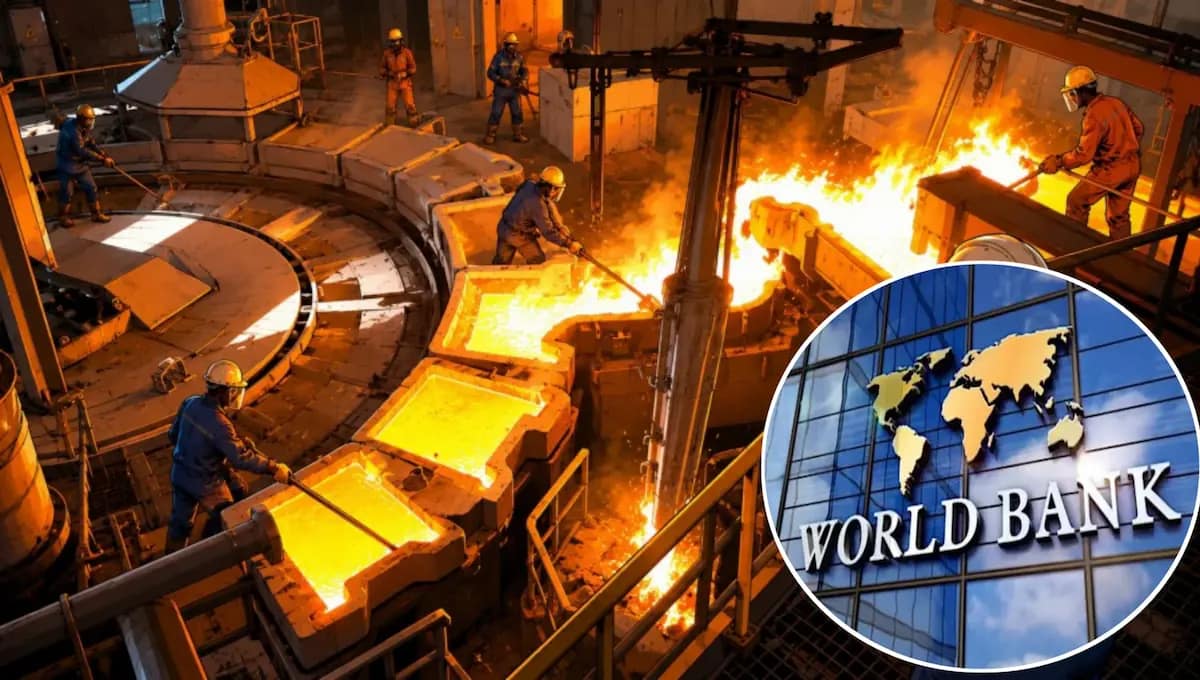
The World Bank Group launched metals and minerals country compacts with Argentina, Bolivia, Egypt, India, Kazakhstan, Malawi, Mauritania and Zambia on October 16, 2026, supporting plans to expand mineral production and domestic processing.
India is pursuing rare-earth processing facilities and critical-mineral industrial parks, while Egypt is targeting new processing hubs. Kazakhstan’s commitments include attracting investment into mineral industries beyond extraction.
The Bank followed on October 30 with details of its RISE+ initiative, which supports the preparation of mineral-processing, refining and related infrastructure projects for investment.
The programme forms part of the World Bank Group’s broader target of $19 billion in metals and minerals financing and private capital mobilisation between fiscal years 2026 and 2030.
Support involves public-sector financing through the World Bank, private investment through the International Finance Corporation and investment guarantees from the Multilateral Investment Guarantee Agency. The target does not represent financing already allocated to the eight countries.
The participating economies have different levels of mineral production and industrial processing capacity. Zambia already operates within an established copper industry, while other countries are seeking investment to develop processing facilities or expand existing operations.
Their commitments bring new industrial projects into consideration for investors, although the country compacts do not establish that those projects have secured financing or entered construction.
Zambia, India and Kazakhstan Target Mineral Processing Expansion
Zambia’s copper-processing industry already has operating capacity. First Quantum Minerals’ Kansanshi smelter near Solwezi has operated since 2015, with an expansion designed to raise concentrate-treatment capacity to 1.6 million tonnes annually and copper anode output to 400,000 tonnes.
The company’s S3 ore-processing expansion entered commercial production in December 2025. Kansanshi produced 45,843 tonnes of copper in the third quarter of 2026, while the smelter earned $33 million from surplus sulphuric acid sales.
Zambia’s World Bank compact supports a national target of three million tonnes of annual copper production by 2031. Reaching that level would require additional mining output alongside the country’s existing smelting operations.
The Kansanshi expansion provides an example of private industrial investment already underway, although it was not announced as a World Bank-financed project.
India has approved ₹7,280 crore for a programme targeting 6,000 tonnes of annual rare-earth permanent magnet manufacturing capacity.
The planned facilities will convert rare-earth oxides into metals, alloys and finished magnets for electric vehicles, wind turbines and industrial equipment.
Five manufacturers are to be selected through competitive bidding, with each permitted to develop up to 1,200 tonnes of capacity. The Ministry of Heavy Industries opened the tender in March 2026, with technical bids opened in August.
Kazakhstan’s Kazakhmys operates the Balkhash metallurgical complex, which has design capacity of 220,000 tonnes of copper cathodes annually.
The government reported a 21.8 billion tenge modernisation programme for the facility in 2026. A separate Qazaq Smelter project carries planned private investment of 750 billion tenge and proposed annual capacity of 300,000 tonnes of copper cathodes. Construction is scheduled for 2027, with commissioning targeted for 2030.
The World Bank’s compacts cover countries with established processing operations as well as those developing new manufacturing capacity. Zambia and Kazakhstan have operating copper facilities, while India’s magnet programme is still selecting manufacturers.
Their expansion plans offer different entry points for industrial investors, with new production dependent on project financing, construction and commissioning.
Global Mineral Buyers Seek Alternatives to Concentrated Refining Supply
China and Indonesia accounted for more than three-quarters of the growth in refined supplies of major energy minerals between 2023 and 2025, according to the International Energy Agency’s Global Critical Minerals Outlook 2026.
China remains the leading refiner for most major critical minerals, while Indonesia dominates nickel processing. Under the IEA’s Stated Policies Scenario, demand for critical minerals is projected to almost double by 2040.
Global copper demand is expected to increase by approximately seven million tonnes by 2040, supported by investment in electricity networks and other industrial applications.
The IEA estimates that announced mining projects leave a potential 25% supply shortfall in 2035. Zambia already supplies copper to international markets, but additional mining production would not necessarily translate into equivalent growth in domestic refining.
Copper smelters face pressure from limited concentrate availability. The 2026 benchmark treatment charge was settled at zero dollars per tonne, reducing a major source of smelting revenue.
China accounted for approximately half of global copper smelting capacity in 2025, while utilisation at facilities outside China fell below 70%. The figures indicate that new smelting investment faces tighter commercial conditions than rising refined-copper demand alone suggests.
China’s share of rare-earth refining stood at approximately 85% in 2025, despite additional production in Malaysia and the United States.
The IEA projects nearly 50,000 tonnes of annual rare-earth mining capacity outside the leading producer by 2035, compared with approximately 18,000 tonnes of planned metal, alloy and magnet capacity.
India’s permanent-magnet manufacturing programme is targeting part of that downstream processing gap.
Chinese rare-earth export controls introduced in April 2025 disrupted supplies of materials used by automotive manufacturers, with some companies reducing or temporarily suspending production.
The IEA estimates that expanded restrictions could expose $6.5 trillion in annual downstream production outside China to supply risks.
India’s proposed magnet facilities would provide additional manufacturing capacity if completed, although production volumes and international purchasing agreements have not been established.
Private Capital Targets Mineral Processing Projects Across Eight Markets
The International Finance Corporation (IFC) signed a $400 million loan agreement with Rio Tinto in March 2026 for the Rincón lithium project in Argentina.
The financing forms part of a $1.175 billion package involving IDB Invest, Japan Bank for International Cooperation and Export Finance Australia. IFC mobilised $775 million from the participating lenders, with its investment records showing the transaction as invested in June.
Rio Tinto is developing a $2.5 billion lithium extraction and processing complex in Salta province to produce battery-grade lithium carbonate. Construction began in 2025, with first production expected in 2028.
The project is designed to produce approximately 53,000 tonnes annually, with a longer-term plan to increase capacity to 60,000 tonnes. IFC’s financing predates the October country compacts and was secured for a development already under construction.
India’s rare-earth magnet manufacturing programme received bids from 20 companies and consortia, including Larsen & Toubro, Attero Recycling, NEO Performance Materials and Lohum Magnets & Energy Solutions.
The Ministry of Heavy Industries opened technical bids in August 2026. The programme offers ₹6,450 crore in sales-linked incentives and ₹750 crore in capital subsidies. The bidders have not yet been identified as recipients of completed investment agreements.
The World Bank detailed its RISE+ initiative on October 30 to support the preparation of mineral-processing, refining and associated infrastructure investments.
IFC is participating through the Comprehensive Japan Trust Fund, with project preparation and risk mitigation included in the programme. The announcement did not identify financing commitments for individual processing facilities in the eight countries.
The Rincón financing demonstrates how a processing project can attract multilateral lenders before commercial production begins.
For facilities still seeking investment, the World Bank’s proposed support addresses project preparation and financing risks, but the country compacts have yet to establish a comparable pipeline of signed processing investments.
World Bank’s Mineral Processing Ambitions Face Production Cost Pressures
Konkola Copper Mines began a 60-day maintenance shutdown at its Nchanga smelter in Zambia on May 29, 2026, to repair and modernise processing equipment.
The company arranged alternative sulphuric acid supplies to maintain operations at its tailings leach plant, including production from its 500-tonne-per-day acid facility. Specialised contractors and equipment suppliers were brought in for the shutdown, with smelting scheduled to resume in August.
Jubilee Metals Group reported that sulphuric acid costs increased by more than 200% during the fourth quarter of its 2026 financial year, while diesel costs rose 90%.
Its Sable refinery produced 1,207 tonnes of copper cathode during the year, up 17.5%. The company also reported temporary closures among other processors in its operating area as higher input costs affected production.
India imports all the sintered neodymium-iron-boron permanent magnets used by its domestic industries, according to the Ministry of Heavy Industries.
Although the country has rare-earth mining, separation and oxide-refining capabilities, it lacks industrial-scale facilities to manufacture the finished magnets.
The ministry projects domestic requirements of 8,220 tonnes annually by 2030, including 3,250 tonnes for electric vehicles and 1,800 tonnes for wind turbines.
The International Energy Agency estimates that developing diversified rare-earth magnet supply chains will require approximately $60 billion over the next decade.
Refining accounts for nearly half of the investment requirement, with magnet manufacturing representing around one-third. Equipment costs, delivery schedules and technical qualification requirements remain significant considerations for manufacturers developing capacity outside China.
The World Bank’s country compacts and RISE+ programme provide support for preparing mineral-processing investments and addressing financing risks.
Their commercial results will depend on whether projects secure sufficient capital to build and operate facilities at costs that compete with established suppliers.
Additional processing capacity in the eight participating countries will become relevant to international buyers as plants enter production and demonstrate reliable deliveries at commercially viable prices.


Recent Comments